

Intraday Review – A Structured Trading Day on 17 April 2026
Friday’s session in Nifty Futures turned out to be a textbook example of how disciplined price-action trading can work effectively when backed by clearly defined levels.
The market opened near the previous day’s closing zone, which immediately indicated that the probability of testing key levels discussed earlier was quite high. Such openings often provide a clean environment where predefined strategies can be executed without emotional interference.
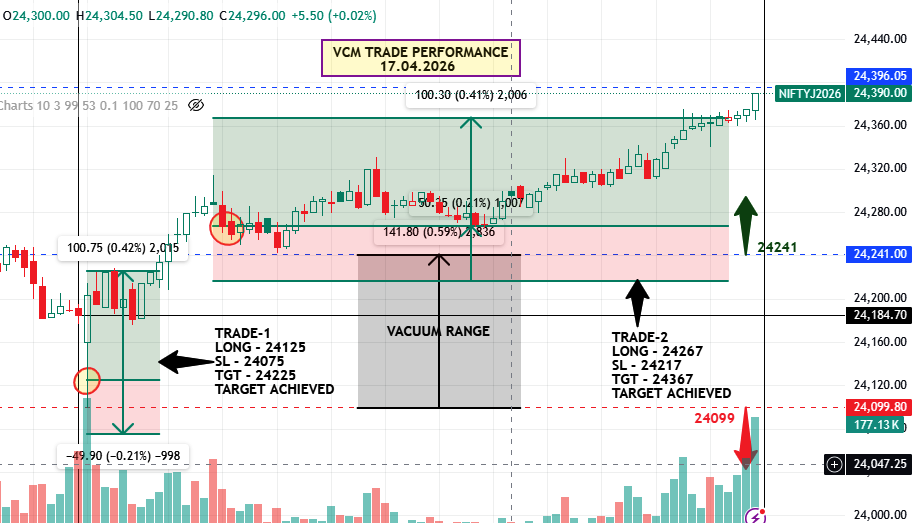
Within the first few minutes of trade, Nifty Futures entered the identified vacuum range and started moving downward with momentum. The early weakness pushed the price toward the lower boundary near 24099. This was a crucial level from a demand perspective, and as per the plan, a buying position had already been placed slightly above this zone with a limited risk.
What followed next was a classic reaction from a strong demand area. The price dipped marginally below the entry zone but found immediate support near the lower band. Buyers stepped in with conviction, and the market reversed sharply.
In a very short span of time, the move unfolded in favor of the trade. The predefined target of 100 points was achieved quickly, while the stop-loss remained completely safe due to its logical placement below the structure. This sequence reinforces an important principle — when trades are aligned with meaningful price zones, the market often respects them with precision.
There was also an interesting development later in the session which serves as a valuable learning point. After the recovery, Nifty Futures continued to gain strength and eventually moved above the upper boundary of the range near 24241 with noticeable participation. In such situations, if the initial range trade had not been triggered, the approach would shift toward a breakout-based opportunity.
A retest of the breakout zone offered another potential entry point. From there as well, the price showed continuation and could have delivered a similar directional move. While the trading framework discourages multiple trades after achieving the first objective, observing such price behavior helps build confidence in the overall methodology.
The broader takeaway remains straightforward. When a trader develops the ability to identify demand and supply zones correctly and combines it with disciplined risk management, trading becomes a structured activity rather than a guessing game. It reduces dependency on multiple indicators and keeps the focus on what truly matters — price behavior.
Market Behaviour – Understanding the Broader Context
The overall tone of the market on Friday reflected underlying strength, even though the opening was slightly cautious.
The Nifty 50 started the session with mild weakness, but that phase did not last long. Within the first ten minutes, buying interest became visible, and the index gradually moved higher throughout the session. By the end of the day, it closed with a gain of around 0.65 percent.
What makes this closing noteworthy is the timing. A positive close going into the weekend often suggests that market participants are relatively comfortable holding positions and are not overly concerned about immediate uncertainties.
From a technical perspective, momentum indicators are also showing stability. The RSI is hovering around the 57 zone, which indicates that strength is building, although the market is not yet in an overbought condition. This leaves room for further upside if supportive factors continue.
On the macro front, there are some supportive elements as well. The Indian Rupee has shown resilience around the 92.84 mark against the US Dollar. At the same time, Brent crude prices have softened slightly and are trading near the 95-dollar zone. Lower crude prices generally act as a supportive factor for an import-heavy economy like India.
When these factors are looked at collectively, the environment appears constructive. However, it is also important to remain balanced in interpretation. Despite the recent strength, the index is still trading below its previous highs by a noticeable margin. This means that while sentiment has improved, a confirmed long-term bullish trend is yet to be established.
For the near term, the level around 24278 on the spot index becomes important. A sustained move below this level could indicate temporary weakness. Until that happens, the market structure appears stable with a positive bias.
Trading Plan for 20 April 2026 – Maintaining Discipline Over Prediction
The approach for the next trading session remains rooted in discipline rather than prediction. The idea is not to forecast the market but to respond to it based on predefined conditions.
The framework allows for a maximum of two trades during the day. Ideally, one should be a range-based opportunity and the other a momentum-based setup if conditions justify. However, if the first trade itself achieves the intended outcome, it is generally advisable to step aside for the rest of the session. This helps in avoiding overtrading and preserves both capital and mental clarity.
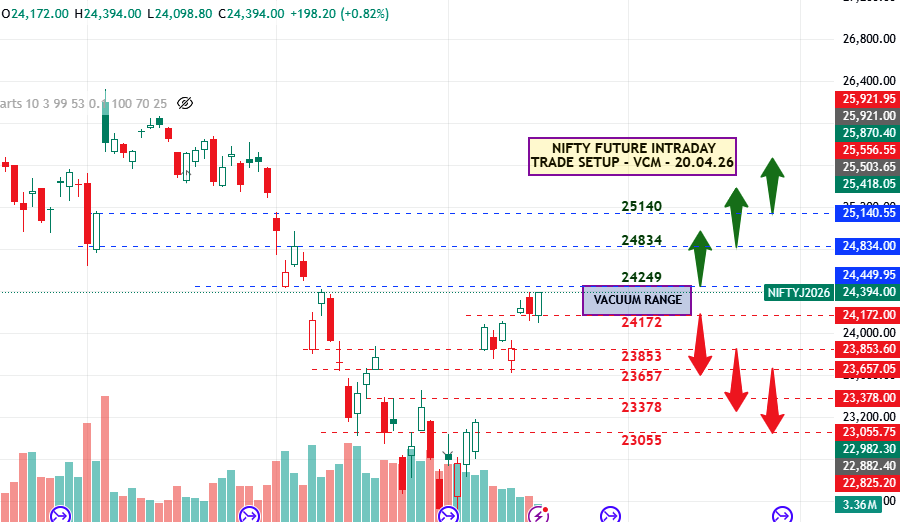
For Monday, the focus remains on the vacuum range between 24249 and 24172 in Nifty Futures.
If the market opens within this zone, the strategy revolves around observing which side of the range gets tested first. If the price approaches the upper boundary, it may offer a short-side opportunity. On the other hand, if the lower boundary is tested first, a long-side setup may emerge.
In both cases, risk control remains non-negotiable. A stop-loss of 50 points and a minimum target of 100 points ensures that the risk-reward structure remains favorable.
If the market does not respect the range and instead moves decisively beyond either boundary, the approach shifts toward momentum trading. A sustained move above 24249 may indicate strength, where long positions can be considered with defined risk parameters. Similarly, a decisive move below 24172 may open up short-side opportunities.
Key levels to watch on the upside include 24834 and 25140, while on the downside, supports can be seen near 23853 and 23657.
In case of a gap-up or gap-down opening outside the defined range, range trading should be avoided entirely for that session. In such situations, waiting for clear directional confirmation becomes more important than forcing trades.
Global Developments – Factors Influencing Market Sentiment
Over the last 24 hours, global developments have played a supportive yet cautious role in shaping sentiment.
There has been some relief in geopolitical tensions with indications of a temporary ceasefire in parts of the Middle East. This has helped stabilize global equity markets and kept crude oil prices under control.
At the same time, risks have not completely disappeared. Disruptions in key trade routes, especially around the Strait of Hormuz, continue to remain a concern. Since a significant portion of global oil and fertilizer supply passes through this region, any instability here can have wider economic implications.
There are also emerging concerns in Europe regarding fuel availability, particularly in the aviation sector. This could have a cascading effect on travel costs and inflation in the coming weeks.
Additionally, food prices are showing signs of pressure due to supply chain disruptions and input cost challenges. This suggests that inflation, although slightly moderated in some areas, may still persist globally.
On the currency front, commodity-linked economies are seeing relative strength, indicating a shift in how global markets are responding to ongoing developments.
Conclusion – Staying Grounded in Process
The recent price action in Nifty Futures highlights an important reality of trading — clarity and discipline often outperform complexity.
The market environment currently shows signs of improving sentiment, but it is still in a transition phase. For traders, the focus should remain on following a structured process, respecting risk, and avoiding unnecessary trades.
Price action continues to remain the most reliable guide. When combined with patience and consistency, it provides a sustainable edge over time. This analysis is purely for educational purposes, aimed at helping traders understand market structure and behavior. It is always advisable to apply personal judgment and risk assessment before taking any trading decisions.
MarkShala – Call to Action
Loved this analysis? Stay ahead in the markets with Markshala’s expert insights. Get deeper market research, trade setups, and investing guidance delivered straight to your inbox.
👉 For collaborations & queries: somnath@markshala.com
👉 WhatsApp Connect: +91 8209177236
Looking to invest in current NFOs or Bonds?
👉 Explore live investment opportunities here: Click Here
Click Here to join our partner Equity / Other Capital Market Investing Platform and unlock MarketShala’s expert-backed investing guidance. You may also join our WhatsApp community MarketShalians to stay tuned with regular updates in your wealth creation journey.
Click Here to join our partner in Crypto Currency Market Investing Platform and unlock MarketShala’s expert-backed investing guidance.
Stay informed. Stay profitable.
– Team Markshala
Disclaimer
The views and analysis provided above are for educational and informational purposes only and should not be considered as financial or investment advice. Trading and investing in the stock market involve risk, and past performance does not guarantee future results.
***********
|| ॐ नमः शिवाय ||