
The Indian stock market continues to operate in an environment where technical structures, global cues, and trader psychology are playing equally important roles in shaping daily price movements. The trading session on Thursday, 16 April 2026 was a good example of how markets can begin with strong optimism but later move into phases of volatility as participants reassess positions during the day.
For traders who closely follow structured trading frameworks, the session offered both a reminder about the importance of disciplined risk management and an opportunity to observe how technical levels influence market behaviour.
In this analysis, we will review the intraday price action in Nifty Futures, discuss the trades executed based on our predefined setup, examine the broader market environment, and outline a technical trading framework for the upcoming session on Friday, 17 April 2026.
It is important to clarify that the purpose of this article is purely educational and analytical, helping traders understand how structured decision-making can be applied to market conditions.
Intraday Trade Review: Nifty Futures on 16 April 2026
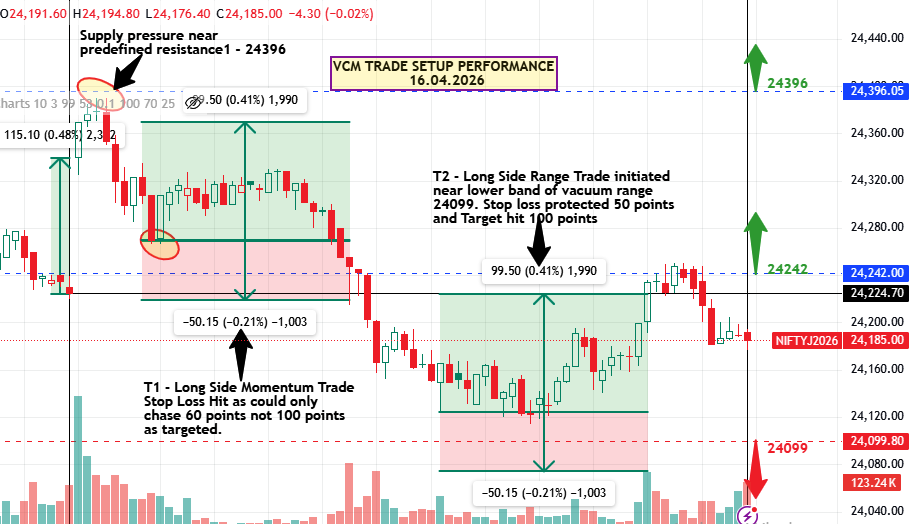
The trading day began with strong positive sentiment, largely influenced by supportive global cues. As a result, Nifty Futures opened with a gap-up of nearly 115 points, which immediately pushed the index significantly above the upper boundary of the vacuum range that had been defined in the earlier trading plan.
A gap-up opening often indicates strong early buying interest, but such openings can also create temporary price imbalances that the market later attempts to correct.
After the opening bell, Nifty Futures continued to extend its gains and gradually moved toward the important resistance level around 24,396. This level had been identified earlier as a potential supply zone based on technical observations.
As the index approached this level, selling pressure began to emerge, and the market started to lose some of its upward momentum. The selling pressure pushed the price back toward the upper boundary of the vacuum range, an area that often acts as a technical pivot zone where traders reassess their positions.
At this stage, a momentum-based long trade was considered within the predefined framework.
The trade structure was carefully designed with strict risk control, keeping the stop loss limited to 50 points. The stop loss was strategically distributed around the upper band level of 24,242, allowing enough room for price fluctuations while still maintaining disciplined risk exposure.
Initially, the market responded positively and the trade started moving in the anticipated direction. Nifty Futures advanced nearly 60 points from the entry zone, indicating that the bullish momentum was still present.
However, financial markets are rarely predictable in a straight line. Soon after the initial rise, selling pressure intensified sharply, and the market reversed its direction.
The reversal was strong enough to eventually trigger the 50-point stop loss, bringing the first trade of the session to a controlled conclusion. While a stop loss may sometimes appear disappointing, it is an essential element of responsible trading because it prevents small losses from turning into larger capital damage.
Once the first trade was closed, the focus naturally shifted back to the broader range structure defined by the trading setup.
The Second Trading Opportunity
Following the momentum trade, the market continued to weaken and gradually moved toward the lower boundary of the vacuum range.
At this stage, according to the trading framework, the only remaining structured opportunity within the range setup was near the lower band.
The logic behind this approach is simple: if the market approaches the lower boundary of a defined range, it often attracts buyers who expect the price to revert back toward the middle or upper portion of that range.
Later in the second half of the trading session, Nifty Futures approached the lower band region near 24,099. As per the setup rules, a range-based long trade was initiated.
The positioning for this trade was designed carefully to maintain the same disciplined risk structure that was applied earlier.
The entry order was placed 25 points above the lower band, while the stop loss was placed 25 points below the lower band, keeping the total risk limited to 50 points.
After the trade was triggered, the market gradually started showing signs of stability. Buying interest returned, and the index began to move upward.
From this region, Nifty Futures eventually produced an upward movement of more than 100 points, validating the logic behind the range-based setup.
Importantly, the stop loss remained protected during the move, allowing the trade to deliver a favourable outcome.
Overall Outcome of the Trading Session
When both trades are evaluated together, the results clearly illustrate the importance of maintaining a structured risk-reward framework.
The first trade ended with a 50-point controlled loss, while the second trade delivered a strong recovery move.
With disciplined trade management and proper adherence to the setup rules, the overall trading book was able to capture a net gain of approximately 50 points per lot.
More importantly, the day reinforced three essential principles that every trader must remember.
Markets reward traders who maintain discipline.
Risk management is more important than predicting market direction.
Patience plays a critical role in waiting for the right opportunity rather than forcing trades.
Broader Market Performance on 16 April 2026
From a broader market perspective, the session reflected a combination of positive sentiment and cautious profit booking.
The day started with optimism supported by global cues, but as intraday volatility increased, some traders preferred to lock in profits.
As a result, the Nifty 50 spot index eventually closed slightly lower by around 0.14 percent.
Despite this modest decline, the underlying technical structure of the market remains relatively stable.
One of the important observations from the daily chart is that the index continues to hold above its 50-day Exponential Moving Average, which is currently acting as an important support level.
The Relative Strength Index (RSI) also remains above the 55 level, suggesting that the broader momentum in the market is still on the positive side.
Another encouraging sign is that market breadth remained healthy, with a larger number of stocks advancing compared to those declining.
In simple terms, the minor decline seen during the day appears to be more of a profit-booking phase rather than a structural change in trend.
Therefore, from a practical perspective, the overall market sentiment remains broadly similar to what it was in the previous trading session.
Trading Framework for the Next Session: 17 April 2026
For the upcoming trading session, the same disciplined trading framework continues to be followed.
This framework is designed to maintain clarity, emotional balance, and controlled risk exposure, particularly during volatile market conditions.
The idea is not to predict the market but rather to react to price behaviour within clearly defined levels.
Under this approach, the trading session ideally involves a maximum of two trades, typically consisting of one range-based trade and one momentum-based trade.
If the first trade of the day achieves its intended target, it is generally advisable to avoid additional trades for the session. This helps traders maintain psychological discipline and avoid unnecessary overtrading.
Range Trading Scenario
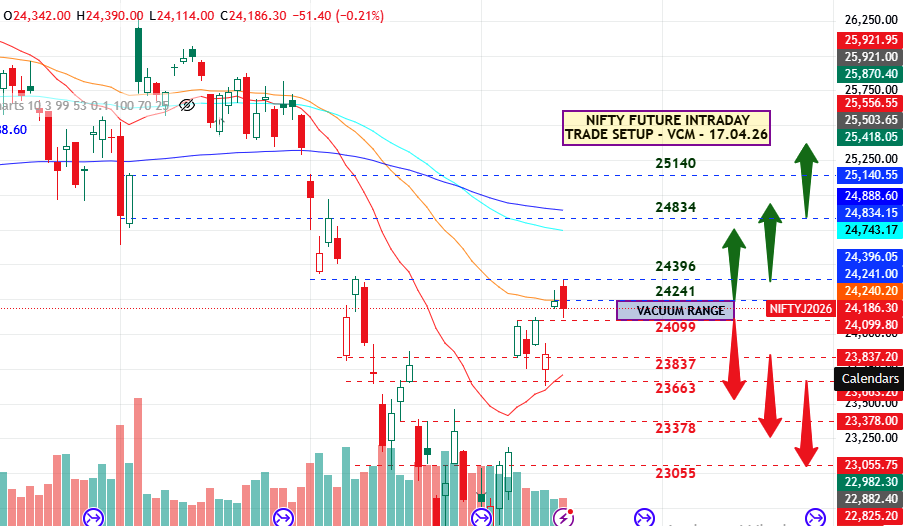
If Nifty Futures opens within the vacuum range of 24,241 to 24,099, traders may observe which boundary of the range is tested first.
If the market approaches the upper boundary first, the zone near 24,241 may attract selling pressure and could become an area where traders monitor for a potential short-side reaction.
On the other hand, if the market declines first and approaches the 24,099 region, it may attract buying interest, which could create a potential long-side opportunity.
In either case, the trading structure continues to maintain a stop loss of 50 points and a minimum target expectation of 100 points, ensuring a favourable risk-to-reward balance.
Momentum Trading Scenario
If the market opens with a strong move outside the defined range, the range setup becomes less relevant and the focus shifts toward momentum-based trading opportunities.
If Nifty Futures trades decisively above 24,241, it may indicate bullish momentum. In such a scenario, traders may monitor the market for a continuation move toward the first resistance level near 24,396, while a stronger move could eventually extend toward 24,834.
Conversely, if Nifty Futures trades decisively below 24,099, the market may enter a bearish momentum phase. Under such conditions, the next technical reference points may appear near 23,837 and 23,663, which could act as potential support zones.
Important Global Developments in the Last 24 Hours
Apart from technical factors, global macroeconomic developments continue to influence investor sentiment across financial markets.
One of the key developments has been the ongoing geopolitical tensions involving Iran, the United States, and Israel, which have created disruptions in the global energy market.
Reports indicate that physical crude oil prices in certain markets have surged toward 120 to 150 dollars per barrel, while futures markets remain significantly lower. This pricing disconnect highlights the uncertainty surrounding supply routes.
The Strait of Hormuz, a critical shipping channel through which a large portion of global oil supply flows, remains at the centre of these concerns. Any disruption in this region could have a meaningful impact on global inflation and energy prices.
Another important development is the decision by the United States to end certain oil sanction waivers related to Iran and Russia. Such policy changes can influence global crude trade patterns and may indirectly affect energy-importing economies such as India.
Meanwhile, central banks around the world are also adopting a cautious approach. The Bank of England has recently indicated that it will not rush into major interest rate decisions, highlighting the uncertainty created by geopolitical tensions and fluctuating commodity prices.
In addition to these developments, gold prices have also shown strength in international markets. A relatively weaker US dollar has increased demand for gold as a safe-haven asset, particularly among investors seeking protection from geopolitical and inflation-related risks.
Final Thoughts
Financial markets rarely move in a straight line. Instead, they evolve through phases of optimism, caution, volatility, and consolidation.
The trading session of 16 April 2026 served as a valuable reminder that discipline, patience, and risk control are more important than attempting to predict every market move.
By following a structured trading framework and respecting clearly defined technical levels, traders can improve their ability to navigate uncertain market environments. As always, market participants should approach trading decisions with careful analysis and remain aware that financial markets involve risk and uncertainty.
MarkShala – Call to Action
Loved this analysis? Stay ahead in the markets with Markshala’s expert insights. Get deeper market research, trade setups, and investing guidance delivered straight to your inbox.
👉 For collaborations & queries: somnath@markshala.com
👉 WhatsApp Connect: +91 8209177236
Looking to invest in current NFOs or Bonds?
👉 Explore live investment opportunities here: Click Here
Click Here to join our partner Equity / Other Capital Market Investing Platform and unlock MarketShala’s expert-backed investing guidance. You may also join our WhatsApp community MarketShalians to stay tuned with regular updates in your wealth creation journey.
Click Here to join our partner in Crypto Currency Market Investing Platform and unlock MarketShala’s expert-backed investing guidance.
Stay informed. Stay profitable.
– Team Markshala
Disclaimer
The views and analysis provided above are for educational and informational purposes only and should not be considered as financial or investment advice. Trading and investing in the stock market involve risk, and past performance does not guarantee future results.
***********
|| ॐ नमः शिवाय ||