

The Indian equity markets witnessed a strong start in today’s session as supportive global cues lifted investor sentiment across Asian markets. However, despite the encouraging opening, intraday price action in Nifty Futures remained relatively subdued as the index spent most of the day consolidating within a narrow range.
For disciplined traders who rely on structured trading frameworks, today’s session once again highlighted an important lesson in market participation — not every day offers a trade opportunity, and sometimes the best decision is to remain patient and avoid unnecessary risk.
In this analysis, we will review today’s price action in Nifty Futures, evaluate the broader technical structure of the Nifty 50 index, and discuss a rule-based trading framework that traders may monitor in the upcoming session.
Nifty Futures Intraday Trade Review – 15 April 2026
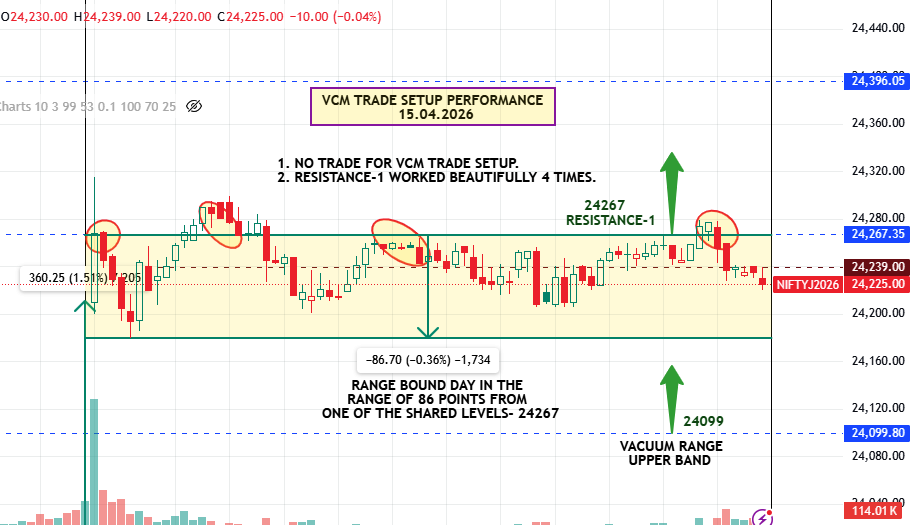
Today’s trading session began with a sharp gap-up opening of nearly 360 points in Nifty Futures. The primary reason behind this strong opening appears to be favourable geopolitical developments that unfolded overnight and improved global risk sentiment.
Such gap-up openings are generally welcomed by long-term investors because they reflect strong buying interest in the market. However, for intraday traders who operate on predefined technical setups, large overnight gaps often make execution slightly more challenging.
In the context of the Vacuum Range (VCM) trading framework that we track regularly, today’s opening occurred well outside the predefined vacuum range. Because of this, the range-based trade setup for the day was automatically nullified.
Once the market opened, Nifty Futures did not revisit the upper boundary of the vacuum range at any point during the session. As a result, traders did not receive a technically valid positioning opportunity for a momentum-based entry either.
When we closely observe the five-minute intraday chart, it becomes evident that the index remained largely rangebound throughout the day. The price movement was confined to a relatively narrow band of approximately eighty to ninety points. During this consolidation phase, the index repeatedly attempted to absorb selling pressure near the resistance zone around 24,267 but failed to generate a strong directional breakout.
From an intraday trading perspective, a session without clear opportunities can sometimes feel disappointing. However, there is another way to interpret such sessions. The absence of trades also means that traders following disciplined strategies successfully avoided being trapped in low-probability setups.
This is precisely why rule-based trading frameworks emphasize patience and discipline. The objective is not to trade every day but to participate only when market conditions align with the strategy.
Based on these observations, today’s session can reasonably be categorized as a No Trade Day within the VCM trading framework.
Broader Market Perspective – Positive Technical Developments
Although intraday opportunities were limited, the broader market structure showed encouraging signs of strength.
The Nifty 50 index closed the day with a gain of approximately 1.63 percent, which is a notable move considering the current global environment. More importantly from a technical perspective, the index managed to close above its 50-day Exponential Moving Average.
Closing above the 50-day moving average is generally considered a constructive signal because it reflects improving short-term momentum and renewed buying interest.
At the moment, both the 20-day and the 50-day moving averages appear to be shifting into potential support zones for the index. If prices continue to hold above these levels, they may provide stability during short-term corrections.
Momentum indicators are also showing gradual improvement. The Relative Strength Index has strengthened further and is now positioned above the 55 level, indicating that bullish momentum is slowly building in the market.
Another positive development is the improvement in overall market breadth. A broad set of stocks across sectors participated in today’s up move, which suggests that buying interest was not limited to a few heavyweight stocks but was visible across multiple segments of the market.
In addition to technical factors, movements in the global commodity markets are also offering some relief. Crude oil prices have once again slipped below the psychologically important 100-dollar mark and are currently trading near the 95-dollar per barrel region. For an energy-importing country like India, softer crude prices are typically viewed as supportive for the broader economy.
A Note on Global Market Context
While the Indian markets have recently shown signs of improvement, it is worth noting that the Nifty index is still trading roughly eight percent below its lifetime highs.
In contrast, major United States indices are currently hovering close to their record levels. This divergence suggests that global investors remain cautiously optimistic about the overall macroeconomic outlook, even as regional markets adjust to evolving geopolitical conditions.
At the same time, certain domestic factors require careful monitoring. Recent economic data has indicated a slight uptick in India’s inflation rate. Additionally, early projections suggest that the upcoming monsoon season may be somewhat weaker than earlier expectations.
Both inflation trends and monsoon performance can influence consumption patterns and rural demand, which in turn may have implications for several sectors of the Indian economy.
It will therefore be interesting to observe how the market absorbs these developments in the coming weeks.
Trading Framework for the Next Session
The trading approach followed in this analysis is based on a disciplined and structured framework that focuses on risk management and probability-based decision making.
The primary objective of such a framework is to reduce emotional trading and encourage consistent execution.
Under this approach, traders generally limit themselves to a maximum of two trades during a session. Ideally, these consist of one range-based trade and one momentum-based trade.
If the first trade successfully reaches its predefined target, it is often considered prudent to avoid additional trades for the rest of the day. Such restraint helps maintain psychological discipline and prevents overtrading, which is one of the most common reasons for trading losses.
Understanding the Range Trading Logic
If Nifty Futures opens within the predefined vacuum range, traders typically begin by observing which side of the range the market tests first.
When price approaches the upper boundary of the range, traders may evaluate the possibility of a short-side trade. Conversely, if price tests the lower boundary first, the setup may favour a long-side trade.
The core principle behind this approach is simple. Instead of predicting market direction in advance, the strategy allows price action itself to indicate the most relevant trade opportunity.
Trade Progression Scenarios
Once a range trade is initiated, two possible scenarios may unfold.
In the first scenario, the market moves favourably and reaches the predefined profit target of one hundred points. In such cases, the position is closed and traders step aside for the rest of the session.
In the second scenario, the market reverses sharply and begins to move in the opposite direction. Such behaviour can sometimes indicate the beginning of a breakout move. When that happens, the strategy shifts focus from range trading to momentum trading, allowing traders to potentially participate in the emerging directional move.
This flexibility allows the trading framework to adapt to changing market conditions while still maintaining disciplined execution.
Handling Gap-Up or Gap-Down Openings
There are sessions when the market opens significantly above or below the defined range due to overnight developments.
In such cases, the range trading setup becomes invalid for the day. Instead of forcing trades within an unsuitable environment, traders may focus only on momentum-based setups while maintaining strict risk management parameters.
Risk Management Principles
Risk control remains the foundation of any sustainable trading strategy.
Within this framework, each trade typically follows a defined risk-reward structure. The stop loss is limited to approximately fifty points, while the minimum target is maintained around one hundred points.
Maintaining such a structure ensures that the reward potential remains at least twice the risk, which is an essential requirement for long-term consistency.
Key Levels to Observe in the Upcoming Session
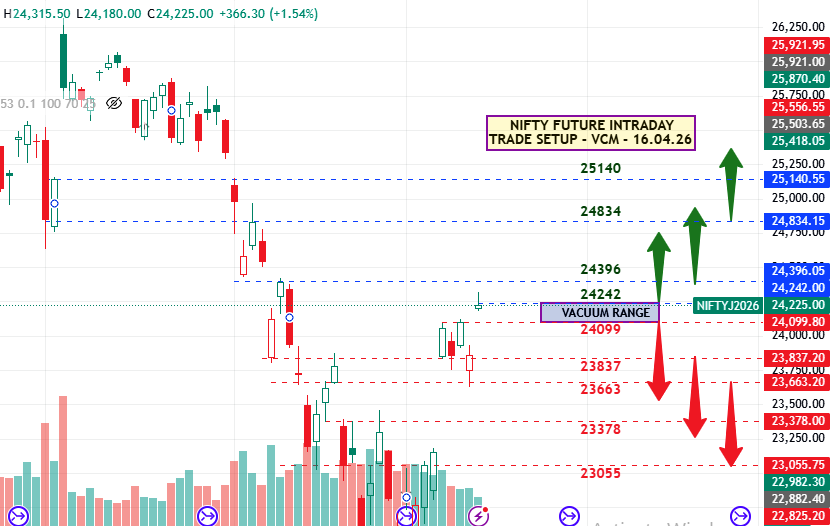
For the next trading session, traders may monitor the vacuum range between 24,242 and 24,099.
If the market opens within this zone and price action confirms the setup, the upper boundary near 24,242 may act as a potential short-side observation area, while the lower boundary near 24,099 may serve as a potential long-side observation area.
In the event of a decisive move above 24,242, the market could enter a momentum phase on the upside. In such a scenario, the next resistance zones to watch may appear near 24,396 and later around 24,834.
On the other hand, if Nifty Futures breaks below 24,099 with conviction, downside momentum could emerge. In that case, the next support areas may be observed near 23,837 and 23,663.
As always, these levels should be interpreted as reference zones within a technical framework rather than guaranteed outcomes, and traders should apply their own judgement and risk management practices.
Important Global Developments from the Last 24 Hours
Several geopolitical and economic developments over the past day have influenced global financial markets.
Reports have emerged suggesting that diplomatic discussions between the United States and Iran may resume in an effort to ease tensions in key shipping and energy routes. Any progress in such negotiations tends to improve risk sentiment in global markets.
At the same time, crude oil prices have declined for a second consecutive session as supply concerns eased slightly. Lower oil prices can help reduce global inflationary pressure and are generally beneficial for economies that rely heavily on energy imports.
Another significant update came from the International Monetary Fund, which recently maintained a positive outlook for India’s economic growth. The institution expects India’s GDP growth for the coming fiscal cycle to remain around the 6.5 percent level, reinforcing India’s status as one of the fastest-growing major economies in the world.
Meanwhile, gold prices have continued to move higher as investors allocate more capital toward safe-haven assets amid ongoing geopolitical uncertainties.
In addition, India’s trade deficit has widened due to an increase in imports. While higher imports often reflect strong domestic demand, sustained deficits can also create pressure on currency stability if they expand significantly over time.
Final Perspective
Today’s session once again demonstrated that successful trading is less about constant activity and more about disciplined decision making.
Markets do not provide high-probability opportunities every day. However, traders who follow structured frameworks and respect risk management principles place themselves in a stronger position to capitalize when favourable setups eventually appear. Consistency in following the process often matters far more than the outcome of any single trading session.
MarkShala – Call to Action
Loved this analysis? Stay ahead in the markets with Markshala’s expert insights. Get deeper market research, trade setups, and investing guidance delivered straight to your inbox.
👉 For collaborations & queries: somnath@markshala.com
👉 WhatsApp Connect: +91 8209177236
Looking to invest in current NFOs or Bonds?
👉 Explore live investment opportunities here: Click Here
Click Here to join our partner Equity / Other Capital Market Investing Platform and unlock MarketShala’s expert-backed investing guidance. You may also join our WhatsApp community MarketShalians to stay tuned with regular updates in your wealth creation journey.
Click Here to join our partner in Crypto Currency Market Investing Platform and unlock MarketShala’s expert-backed investing guidance.
Stay informed. Stay profitable.
– Team Markshala
Disclaimer
The views and analysis provided above are for educational and informational purposes only and should not be considered as financial or investment advice. Trading and investing in the stock market involve risk, and past performance does not guarantee future results.
***********
|| ॐ नमः शिवाय ||