
The Indian equity market started the week on a volatile note on Monday, 13 April 2026. Global geopolitical tensions, particularly developments in the Middle East, triggered a wave of risk aversion across global markets. As a result, Indian indices opened sharply lower, reflecting the nervous sentiment prevailing among investors and traders.
Despite the panic visible during the opening minutes of the session, the market later showed resilience. Buyers gradually emerged from lower levels and helped reduce the intensity of the fall by the time markets closed.
In this article, we will take a detailed look at the intraday price action in Nifty Futures, evaluate the broader market behaviour, review important macro developments affecting sentiment, and finally discuss a structured trading framework for the next trading session on Wednesday, 15 April 2026.
Review of Today’s Intraday Trade – 13 April 2026
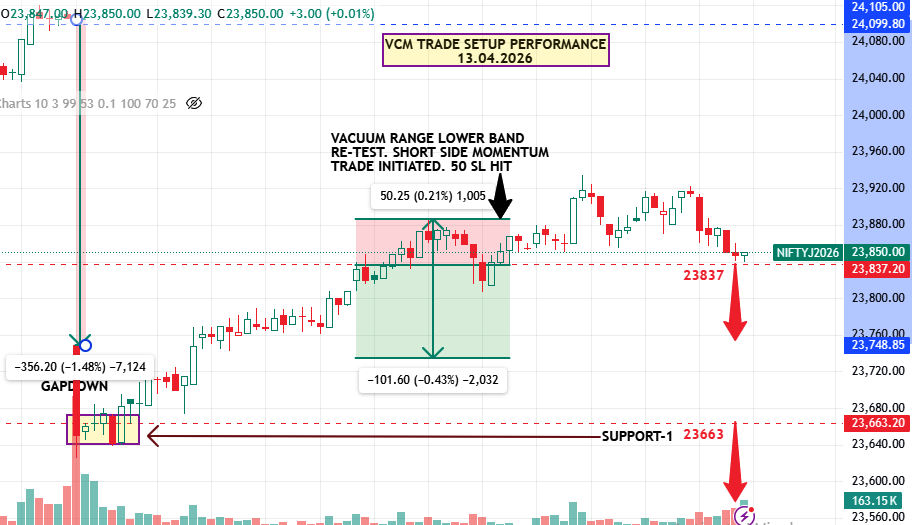
During today’s trading session, the VCM intraday framework provided only one trade opportunity in accordance with the defined rules of the system.
If we observe the five-minute intraday chart of Nifty Futures, the most striking feature of the day was the massive gap-down opening. The market opened nearly 356 points lower compared to the previous session’s closing levels. Because of this steep fall, the opening price was significantly below the lower boundary of the predefined vacuum range.
Within the first five minutes itself, the index quickly moved down and reached the Support-1 level.
After witnessing such a sharp fall right at the opening bell, initiating a fresh short-side momentum trade at those levels would not have been a high-probability decision. Markets often tend to pause or bounce after such aggressive declines, and therefore patience becomes an essential part of disciplined trading.
As expected, Nifty Futures began to absorb the selling pressure near Support-1 and gradually moved upward. This recovery phase pushed prices back toward the lower boundary of the vacuum range.
When the market approached the level of 23837, which represented the lower band of the range, a short-side momentum trade was initiated. The underlying probability behind this trade was that supply could emerge near that zone after the recovery from lower levels.
However, markets do not always behave according to expectations. Instead of facing fresh selling pressure, the index continued to recover further. As a result, the predefined stop loss of 50 points was triggered.
Interestingly, the recovery in the market did not stop there. Even after the stop loss was hit, the market continued to move higher.
This marks the second consecutive trading session in which the stop loss has been triggered. Such phases are often mentally challenging for traders because they test patience and discipline.
Nevertheless, the most important lesson from today’s session lies in risk management. By respecting the 50-point stop loss, the potential loss was controlled. Had the stop loss not been followed strictly, the loss could easily have expanded to around 100 points or more. In that scenario, the entire risk-reward equation and money management framework would have been compromised.
Professional trading is not about avoiding losses altogether. Rather, it is about ensuring that losses remain controlled while opportunities are allowed to develop when probabilities are favourable.
Market Behaviour on 13 April 2026
The broader market movement today clearly reflected the influence of global developments.
The sharp gap-down opening was largely triggered by geopolitical concerns, which had already started affecting global financial markets before the Indian market opened. At one stage during the session, the Nifty 50 index was trading more than 500 points lower.
However, the second half of the session witnessed gradual recovery. Buying interest from lower levels helped reduce the magnitude of the fall, and eventually the Nifty 50 Spot Index closed with a decline of approximately 207 points.
From a technical perspective, today’s closing carries both constructive and cautionary signals.
One positive observation is that the index managed to close above the Support-1 level of 23782. This indicates that buyers were active near that zone.
Another noteworthy technical observation is that the recovery occurred almost precisely near the 20-day exponential moving average. Such behaviour often suggests that the market still considers this area as an important dynamic support level.
Momentum indicators also remain relatively stable. The Relative Strength Index continues to remain above the 50 mark, which implies that the broader trend has not weakened dramatically yet.
However, certain macro signals suggest that volatility may persist in the coming sessions.
India VIX has once again climbed above the level of 20, indicating a rise in market fear and uncertainty. When volatility indicators move higher, price swings often become sharper and less predictable.
At the same time, the Indian rupee has weakened and is currently trading around ₹93.31 against the US dollar. Currency weakness generally reflects global capital flows moving toward safer assets.
Another factor adding to the uncertainty is the rise in crude oil prices. Brent crude, which had comfortably fallen below the $100 level earlier, has again climbed above that mark and is currently trading near $101.89 per barrel.
For an oil-importing country like India, sustained increases in crude oil prices can influence inflation expectations and economic sentiment.
Global Developments Influencing Market Sentiment
The major driver behind the recent volatility is the escalation of tensions between the United States and Iran.
Diplomatic negotiations between the two countries have reportedly failed to produce a meaningful outcome, which has raised concerns about energy supply disruptions in global markets. The Strait of Hormuz, a key route through which a significant portion of global oil supply travels, has become a focal point of attention.
Whenever geopolitical tensions affect energy supply routes, financial markets tend to react quickly. Rising oil prices increase inflation concerns globally and often trigger risk-off sentiment among investors.
In addition to this, political statements and policy signals from global leaders have added further uncertainty to the economic outlook. Markets typically prefer clarity and stability, and therefore unpredictable geopolitical developments can amplify volatility.
At present, there does not appear to be any immediate diplomatic breakthrough on the horizon. As a result, markets around the world remain cautious.
For traders and investors, it is important to remember that geopolitical volatility tends to be temporary in nature. Over time, markets usually adapt and stabilise once the uncertainty begins to fade.
Important Calendar Factor for Indian Markets
An important point to note is that Indian stock markets will remain closed tomorrow. However, global markets will continue to operate during this period.
This creates a situation where two days of global developments and geopolitical reactions will accumulate before Indian markets reopen.
When trading resumes on Wednesday, 15 April 2026, Indian markets will need to adjust to whatever developments occur in global markets during this period. This means that the opening on Wednesday could be influenced significantly by international cues.
If global sentiment improves, markets may open with optimism. On the other hand, if geopolitical tensions intensify further, volatility could remain elevated.
In such situations, maintaining emotional balance becomes extremely important for traders.
Trading Framework for Nifty Futures – 15 April 2026
The trading approach followed here is based on a disciplined and rule-based framework designed to manage risk and maintain emotional control. The objective is not to predict the market but to respond to price action with clearly defined rules.
The framework emphasises limiting trade frequency and maintaining favourable risk-reward conditions.
Ideally, traders should avoid taking more than two trades during a session. The preferred structure is to initiate one range-based trade and, if required, one momentum-based trade.
If the first trade itself reaches its target, it is generally advisable to step aside and avoid further trading for the day. This practice helps maintain psychological discipline and prevents overtrading.
Range Trading Conditions
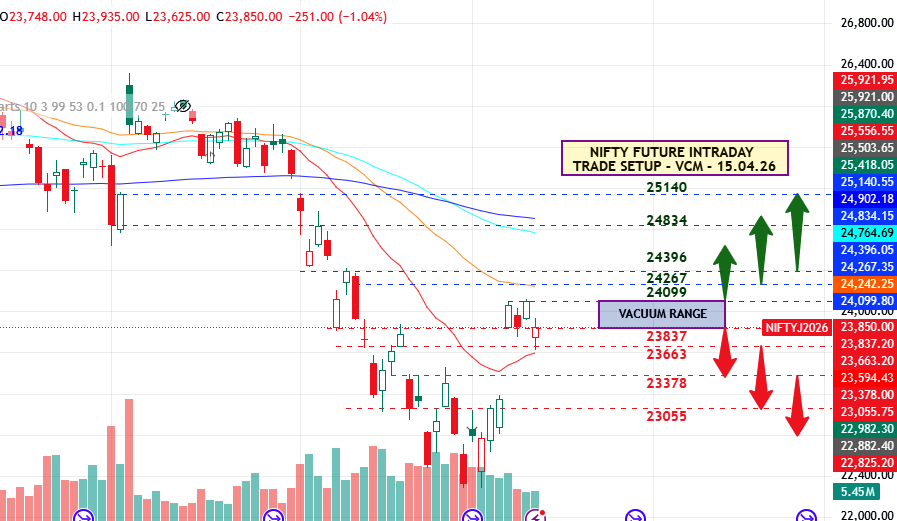
If Nifty Futures opens within the predefined vacuum range between 24099 and 23837, traders may observe how price behaves within this zone.
If the market first approaches the upper boundary of the range near 24099, a short-side trade may be considered around that level, provided price behaviour supports the setup.
Similarly, if the market moves toward the lower boundary near 23837, a long-side trade may be considered around that area.
In both cases, maintaining risk control is essential. The stop loss should remain limited to 50 points, while the minimum expected target should be around 100 points, ensuring a favourable risk-reward structure.
Momentum Trading Possibilities
If the market does not remain inside the range and instead begins trading decisively beyond the boundaries, a momentum-based approach becomes more appropriate.
If Nifty Futures manages to sustain trading above 24099 with strong price action, a long-side momentum opportunity may develop. In such a scenario, the next technical resistance levels could appear near 24267 and later around 24396.
On the other hand, if the index breaks below 23837 with convincing downside momentum, a short-side opportunity may emerge. In that case, traders may observe potential support zones near 23663 and later around 23378.
As always, the emphasis should remain on disciplined risk management, with the stop loss restricted to around 50 points and a minimum target of approximately 100 points.
Final Thoughts
The current market environment reflects a mixture of technical resilience and macro uncertainty. While technical indicators suggest that buyers are still defending important support zones, geopolitical developments continue to create sudden waves of volatility.
In such conditions, emotional decision-making can become a trader’s biggest enemy. A structured trading framework, strict risk management, and patience are essential tools for navigating uncertain markets.
Markets have always experienced periods of turbulence, but history shows that volatility eventually subsides. Therefore, maintaining calmness and discipline during challenging phases is often the most valuable strategy. As always, the focus should remain on process rather than prediction.
MarkShala – Call to Action
Loved this analysis? Stay ahead in the markets with Markshala’s expert insights. Get deeper market research, trade setups, and investing guidance delivered straight to your inbox.
👉 For collaborations & queries: somnath@markshala.com
👉 WhatsApp Connect: +91 8209177236
Looking to invest in current NFOs or Bonds?
👉 Explore live investment opportunities here: Click Here
Click Here to join our partner Equity / Other Capital Market Investing Platform and unlock MarketShala’s expert-backed investing guidance. You may also join our WhatsApp community MarketShalians to stay tuned with regular updates in your wealth creation journey.
Click Here to join our partner in Crypto Currency Market Investing Platform and unlock MarketShala’s expert-backed investing guidance.
Stay informed. Stay profitable.
– Team Markshala
Disclaimer
The views and analysis provided above are for educational and informational purposes only and should not be considered as financial or investment advice. Trading and investing in the stock market involve risk, and past performance does not guarantee future results.
***********
|| ॐ नमः शिवाय ||