
The Indian equity markets once again demonstrated resilience during Tuesday’s trading session. Despite beginning the day under the influence of weak global cues, the market gradually stabilized and ended the session with a relatively firm tone. Such price behaviour has been visible for the past few sessions and reflects the ongoing tug of war between cautious global sentiment and underlying domestic strength.
In this article, we take a closer look at the intraday price action in Nifty Futures on Tuesday, 7 April 2026, understand how the important technical levels influenced the movement during the day, and discuss a structured trading framework for the next session on Wednesday, 8 April 2026. The analysis is based on price behaviour, technical zones and disciplined risk management rather than prediction-based trading.
Intraday Review: Nifty Futures on 7 April 2026
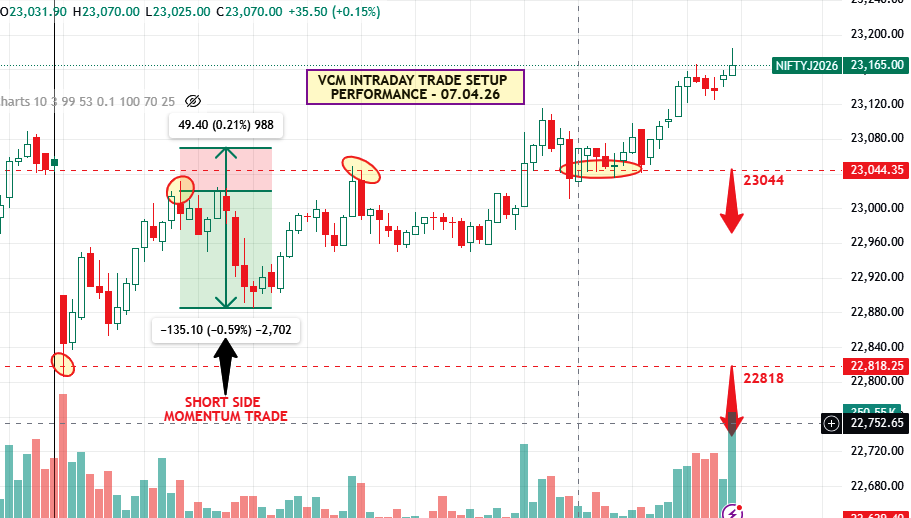
During the trading session of 7 April 2026, the VCM intraday trading framework generated a short-side momentum opportunity in Nifty Futures. Observing the five-minute timeframe chart of the contract clearly explains how the trade evolved during the session.
The day started with a gap-down opening, reflecting the cautious tone prevailing in global markets. This early weakness was largely linked to negative international sentiment and geopolitical concerns which had been influencing investor behaviour across global equities.
Because of the gap-down start, Nifty Futures opened significantly below the previously defined vacuum range lower boundary of 23044. This development immediately altered the trading approach for the day.
The first implication was that the range-based trade setup discussed earlier became invalid. Range strategies typically work best when the market opens within the predefined trading band. Once price opens outside that band, the probability of range trading reduces and the focus naturally shifts toward momentum-based opportunities.
The second step was therefore to patiently observe whether the market would either recover toward the previously important level of 23044 or break decisively below the first visible support around 22818. Both scenarios had the potential to generate a momentum trade.
As the session progressed, the first scenario started unfolding. Nifty Futures gradually recovered from lower levels and approached the 23044 zone from below. This level had earlier acted as a key boundary of the vacuum range, and therefore it was logical to observe whether supply would emerge there.
Interestingly, the market responded exactly in that manner. As the price approached the 23044 area, selling pressure appeared and the zone acted as a supply region. This behaviour provided a technical opportunity to initiate a short-side momentum trade while maintaining a controlled stop loss of approximately fifty points above the level.
Once selling momentum resumed, the market moved lower with reasonable pace. The downside movement extended to nearly 135 points from the entry area, and therefore achieving a 100-point profit objective became relatively straightforward during the session.
Looking back at the entire intraday structure, two price levels dominated the market behaviour throughout the day. These were 23044 on the higher side and 22818 on the lower side. Most of the intraday price movement revolved around these zones, highlighting once again how important clearly defined levels can be in technical trading.
Understanding the Broader Market Behaviour
Apart from the intraday trade itself, the broader behaviour of the market during the past few sessions deserves attention.
Tuesday’s session marked the third consecutive day where a similar pattern was visible. The market opened under pressure due to global developments, initially extended the weakness during early hours, and then gradually recovered as the session progressed.
Such price behaviour often indicates that short-term weak hands are getting shaken out during early declines, after which stronger participants begin accumulating positions at lower levels. While it is still too early to declare that a confirmed market bottom has formed, repeated intraday recoveries certainly indicate that buying interest is emerging at lower levels.
From a technical perspective, a more convincing signal of a potential bottom formation would emerge only if Nifty Spot manages to close above its 20-day exponential moving average, currently located near the 23366 zone. Until such confirmation appears, the market may continue to remain sensitive to both global developments and domestic cues.
Key Indicators from Tuesday’s Session
The closing data from Tuesday also offered some useful insights into market sentiment.
The Nifty 50 index ended the session with a gain of around 0.68 percent, which reflects a relatively stable underlying structure despite the uncertain opening. Market breadth remained reasonably healthy, suggesting that participation was not limited to just a few large stocks.
Another important development was visible in the volatility indicator. India VIX declined to approximately 24.69, indicating that the immediate sense of panic in the market has eased somewhat compared to earlier sessions.
Currency movement also appeared supportive. The Indian Rupee displayed mild strength against the US Dollar, trading close to the 83-per-dollar region. A stable or strengthening rupee generally provides a supportive backdrop for domestic equities because it reduces imported inflation concerns and improves foreign investor sentiment.
Global Developments That Could Influence Markets
While domestic indicators showed signs of stability, global developments continue to remain a major factor influencing market sentiment.
One of the most closely watched developments currently relates to geopolitical tensions involving the United States and Iran. Statements from global leadership have created uncertainty regarding possible actions if negotiations fail. According to widely reported timelines, an important development could emerge around 05:30 AM Indian Standard Time.
Because of this situation, global markets are currently adopting a wait-and-watch approach, and the reaction of international markets overnight could influence the opening tone of Indian equities in the next trading session.
Trading Framework for Nifty Futures – 8 April 2026
For the upcoming trading session, the approach remains structured and rule-based. The focus is not on predicting the market direction but rather on preparing for different possible scenarios and responding to price behaviour accordingly.
The trading framework emphasises discipline, limited trade frequency and strict risk management. Ideally, traders should consider restricting themselves to a maximum of two trades during the day. These typically include one range-based opportunity and one momentum-based opportunity. If the first trade itself achieves the desired objective, it is generally advisable to avoid further entries for the day.
Range Trading Scenario
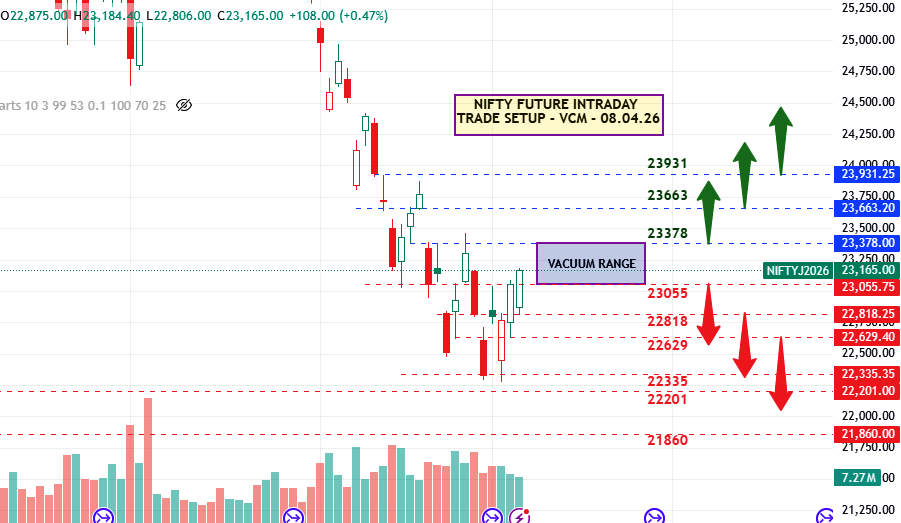
If Nifty Futures opens within the vacuum range of 23378 and 23055, traders may observe how price behaves near the boundaries of this range.
If the market first approaches the upper boundary near 23378, the behaviour of price action in that region could indicate a possible short-side opportunity. Conversely, if the market moves toward the lower boundary near 23055, price stability or demand in that region could open the possibility for a long-side range trade.
In both cases, the framework remains consistent: approximately fifty points of stop loss with a minimum objective of one hundred points. Such positioning helps maintain a favourable risk-to-reward balance.
Long Momentum Scenario
If the market opens strong or later begins to trade decisively above 23378, the range framework becomes less relevant and momentum participation may become the focus.
In such a scenario, the next visible resistance zones on the chart are located near 23663 and 23931. These areas may act as potential supply zones during upward movement and therefore remain important reference points.
Short Momentum Scenario
Similarly, if Nifty Futures breaks and sustains below 23055, it could indicate increasing downside momentum. In that case, traders observing the price structure may monitor the next important support zones around 22818 and 22629.
As always, the emphasis remains on disciplined execution and risk management rather than aggressive trading.
Key Global Economic Developments in the Last 24 Hours
Recent global developments also continue to influence financial markets.
The International Monetary Fund has warned that geopolitical tensions in the Middle East could contribute to slower global economic growth and higher inflation, primarily through disruptions in energy supply. Such developments often increase volatility in commodity markets and can influence global inflation expectations.
Reports have also indicated that India may consider limited fiscal controls to manage pressure arising from subsidies and global uncertainties, although infrastructure investment is expected to remain a priority area of government spending.
Another development attracting attention is the repayment of a significant external loan by Pakistan to the United Arab Emirates, which highlights ongoing pressure on Pakistan’s foreign exchange reserves.
In the commodities market, gold prices have shown strength as investors seek safe-haven assets during geopolitical uncertainty. Meanwhile, economic data from Europe suggests that the United Kingdom’s automobile market recorded notable growth during March, indicating that consumer demand in certain developed markets remains relatively resilient.
Concluding Perspective
The recent behaviour of the Indian equity market highlights the importance of patience and disciplined trading. Despite negative global triggers, the market has repeatedly shown the ability to recover from lower levels. This suggests that underlying demand may still be present, although confirmation of a larger trend reversal will require stronger technical signals.
For the upcoming session on 8 April 2026, the zones around 23378 and 23055 remain the key reference levels for Nifty Futures. How the market behaves around these areas will likely determine the next intraday opportunity. As always, the focus should remain on structured execution, controlled risk exposure and emotional discipline, which are the essential elements for long-term sustainability in trading.
MarkShala – Call to Action
Loved this analysis? Stay ahead in the markets with Markshala’s expert insights. Get deeper market research, trade setups, and investing guidance delivered straight to your inbox.
👉 For collaborations & queries: somnath@markshala.com
👉 WhatsApp Connect: +91 8209177236
Looking to invest in current NFOs or Bonds?
👉 Explore live investment opportunities here: Click Here
Click Here to join our partner Equity / Other Capital Market Investing Platform and unlock MarketShala’s expert-backed investing guidance. You may also join our WhatsApp community MarketShalians to stay tuned with regular updates in your wealth creation journey.
Click Here to join our partner in Crypto Currency Market Investing Platform and unlock MarketShala’s expert-backed investing guidance.
Stay informed. Stay profitable.
– Team Markshala
Disclaimer
The views and analysis provided above are for educational and informational purposes only and should not be considered as financial or investment advice. Trading and investing in the stock market involve risk, and past performance does not guarantee future results.
***********
|| ॐ नमः शिवाय ||