
The Indian equity markets witnessed another difficult trading session on Monday, 30 March 2026. Persistent global uncertainty, heavy selling by foreign institutional investors, and rising geopolitical tensions continued to weigh heavily on market sentiment. Volatility remained elevated throughout the day, and traders were forced to operate in an environment where discipline and risk management became far more important than aggressive positioning.
In this article, we analyse the price action seen in Nifty Futures during today’s session, explain why our trading framework did not trigger a valid intraday opportunity, discuss the broader market environment, and outline a structured trading strategy for the next session on Wednesday, 1 April 2026.
Nifty Futures Intraday Trade Review – 30 March 2026
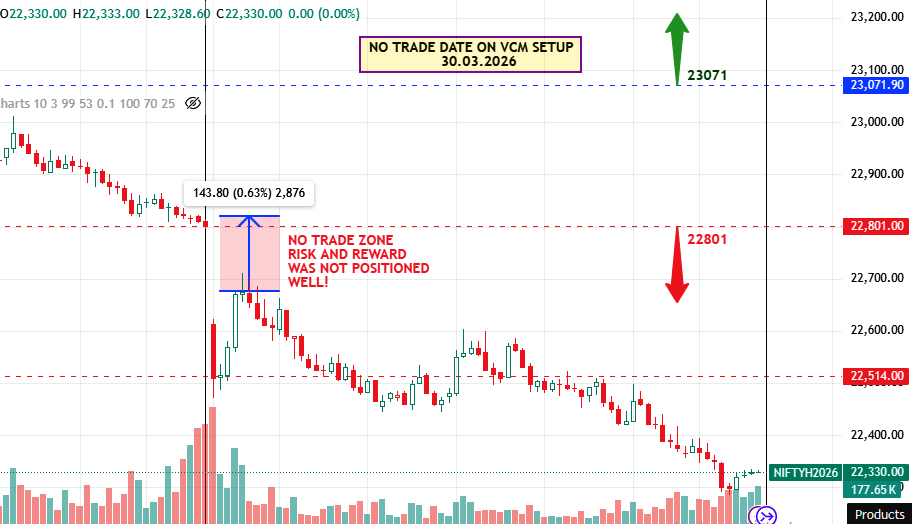
At first glance, the intraday chart of Nifty Futures on a five-minute timeframe seemed to present a day full of trading momentum. The market moved sharply after the opening bell and displayed significant volatility during the session. On the surface, such conditions often attract intraday traders because they suggest the possibility of strong directional moves.
However, when trading through a rule-based and structured setup, every volatile day does not automatically translate into a trade opportunity. A disciplined trading system sometimes requires patience, and occasionally the best decision is to stay out of the market.
This was precisely the case today with our Vacuum Range based VCM trading setup.
The market opened with a noticeable gap down, and importantly, the opening occurred well outside the predefined vacuum range used in our strategy framework. Under such circumstances, the primary step is not to rush into a position but to patiently observe whether price action gradually moves back toward the actionable levels.
During the session, Nifty Futures did approach the lower boundary area and even showed signs of a short-term reversal. However, when we evaluated the positioning from a strict risk-reward perspective, the setup did not justify initiating a trade. The nearest resistance level was not positioned within a 50-point stop-loss zone, which is a key requirement under our framework.
Taking a short trade under these circumstances would have meant entering a position without the necessary risk control parameters. Such trades often become speculative rather than systematic. Since our trading methodology is built around disciplined execution rather than impulsive trading, the setup did not meet the criteria required for entry.
One important point worth highlighting is that this particular strategy does not rely on conventional technical indicators. There is no dependence on oscillators, moving averages, or external data feeds. The entire framework is built on a very simple yet powerful combination of price levels, disciplined risk management, and favourable risk-reward positioning.
Over time, the consistent performance of this approach has demonstrated that trading does not necessarily require complex tools. Often, a structured rule-based methodology combined with patience and capital protection can deliver sustainable outcomes.
Therefore, despite visible market movement, the conclusion for the day remained clear. Monday, 30 March 2026 was categorised as a “No Trade Day” under our system rules.
Maintaining discipline in such situations is a critical component of professional trading.
Market Overview – Another Difficult Session for Indian Equities
The broader Indian stock market also witnessed another round of significant selling pressure during Monday’s session. The Nifty 50 index declined by approximately 2.14 percent during the day, extending the ongoing correction that has been unfolding over the past few weeks.
From its recent peak, the index has now corrected by roughly 15.3 percent. While market corrections are a natural part of long-term investing cycles, the current phase has been particularly challenging because multiple negative factors are influencing investor sentiment simultaneously.
Another concerning development came from the currency market. The Indian Rupee weakened further and touched fresh historical lows against the US dollar. The Reserve Bank of India attempted to stabilise the currency by placing certain restrictions on banks’ dollar exposure, but the pressure on the rupee continued despite these measures.
Currency weakness often amplifies concerns for global investors because it affects capital flows, import costs, and macroeconomic stability.
Given the sharp fall in prices, market breadth remained extremely weak throughout the session. A large number of stocks across sectors traded in negative territory, reflecting broad-based selling rather than sector-specific pressure.
Foreign Institutional Investors continued to remain aggressive sellers in the Indian equity market. Although Domestic Institutional Investors have been providing some buying support, their participation has not been sufficient to completely offset the scale of foreign outflows.
Retail investors and smaller market participants are also beginning to feel the emotional impact of this prolonged volatility. Sentiment indicators suggest that patience levels are gradually declining as uncertainty continues to dominate the market narrative.
Volatility remains elevated as reflected by India VIX levels around 28. Such readings indicate a high degree of nervousness among market participants.
Many investors are comparing the current environment to the difficult period witnessed during the COVID-19 crisis, although the triggers today are largely geopolitical and macroeconomic in nature.
Market Holiday Provides a Short Pause
Indian stock markets will remain closed tomorrow on the occasion of Mahaveer Jayanti. While a trading holiday does not directly influence market direction, it does provide investors and traders with a short pause during a stressful period.
Over the next forty-eight hours, global developments will continue to be closely monitored. Any positive geopolitical signal during this period could potentially improve investor sentiment as the market enters the first trading session of April.
For now, participants can only hope that the coming days bring some stability to global conditions.
Nifty Futures Trading Strategy for Wednesday, 1 April 2026
The trading approach used for Nifty Futures remains grounded in a disciplined and structured framework. The objective is not to chase every market move but to participate only when the probability structure supports a favourable outcome.
The philosophy behind the framework emphasises capital protection, emotional control, and clarity of execution.
A trader following this system should ideally limit activity to a maximum of two trades during the session. Typically, this includes one range-based opportunity and one potential momentum trade if market conditions evolve accordingly.
If the first trade of the day reaches its intended target, it is generally advisable to avoid initiating further trades. This principle helps maintain discipline and prevents unnecessary overtrading.
Primary Trade Logic
The core structure of the strategy revolves around a predefined vacuum range.
If Nifty Futures opens within this range, the first step is observation rather than immediate action. Traders should monitor which side of the range the market approaches first.
If the upper boundary is tested first, the setup may offer a short-side opportunity. If the lower boundary is approached first, a long-side trade may become relevant.
This method ensures that trading decisions are based on real-time price behaviour rather than prediction.
Trade Progression
Once a range trade is initiated, two outcomes are possible.
In the first situation, the trade progresses smoothly and reaches the predefined target of one hundred points. If this occurs, it is generally considered prudent to close the position and avoid additional trades for the session.
In the second scenario, the market reverses direction and breaks out of the range decisively. When such a situation develops, the strategy shifts focus from range trading to momentum trading so that traders can potentially participate in directional moves.
This flexible structure allows the framework to adapt to changing market conditions.
Gap Opening Scenario
If Nifty Futures opens significantly above or below the vacuum range due to a gap-up or gap-down opening, the range trade setup becomes invalid for the day.
In such cases, traders should concentrate only on momentum opportunities while maintaining strict risk discipline.
Risk Management Principles
Risk control remains the most important pillar of this trading framework. For every trade, the stop-loss is restricted to fifty points, while the minimum target remains one hundred points. This structure maintains a favourable risk-to-reward ratio of approximately one to two, which is essential for consistency over a long series of trades.
Key Price Levels for 1 April 2026
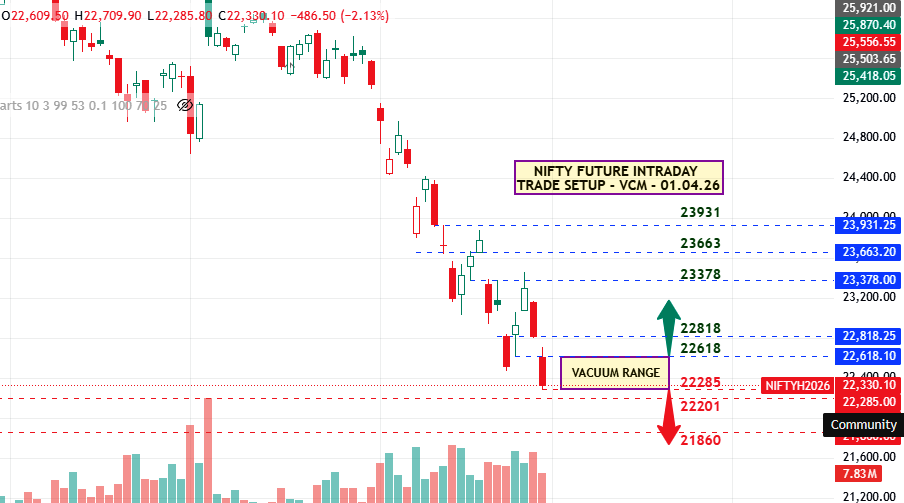
For the next trading session, the vacuum range for Nifty Futures is defined between 22618 and 22285.
If the market opens within this range, a short-side opportunity may emerge near the upper boundary around 22618, while a potential long-side trade may develop near the lower boundary around 22285, always keeping the predefined stop-loss and target parameters in mind.
If the market shows decisive strength and sustains above 22618, a momentum move on the upside could develop. In such a case, resistance may appear around 22818 initially, followed by a higher resistance zone near 23378.
On the other hand, if Nifty Futures breaks below 22285 with conviction, the downside momentum could extend toward support levels around 22201 and possibly further toward 21860.
These levels should be viewed strictly as reference zones derived from technical observations and not as guaranteed market outcomes.
Global Developments Influencing Markets
Over the past twenty-four hours, global geopolitical developments have continued to dominate financial market sentiment.
Tensions in the Middle East have intensified, particularly involving the United States, Israel, and Iran. Reports surrounding potential developments related to Iran’s strategic oil infrastructure have raised concerns about a broader regional conflict.
Such developments often increase global risk perception and lead investors toward safe-haven assets such as gold and the US dollar.
At the same time, crude oil prices have surged sharply, moving above the range of 115 to 120 dollars per barrel. The disruption risk in the Strait of Hormuz is a critical factor behind this movement. This maritime corridor is one of the most important energy transit routes globally, with nearly twenty percent of the world’s oil supply passing through it.
Higher energy prices raise inflation risks worldwide and create additional pressure on oil-importing countries like India.
Asian equity markets also reacted negatively to these developments. Major indices such as Japan’s Nikkei and South Korea’s KOSPI recorded notable declines as investors reassessed global risk conditions.
Another concern emerging in global economic discussions is the possibility of stagflation. Rising energy prices combined with slowing economic growth could create a challenging policy environment for central banks.
If inflation remains elevated, central banks may find it difficult to implement aggressive interest rate cuts, which could further influence global liquidity conditions.
Final Thoughts
The current market environment remains highly sensitive to geopolitical developments and global macroeconomic signals.
Factors such as rising crude oil prices, continued foreign institutional selling, currency weakness, and elevated volatility are collectively influencing market behaviour.
During such phases, the importance of disciplined trading and strict risk management becomes even more significant.
For traders and investors alike, patience and structured decision-making are essential while navigating this uncertain environment.
As the new financial year begins, markets may experience further volatility before establishing a clearer direction. Until then, following a rule-based strategy and maintaining emotional balance can be the most effective approach.
MarkShala – Call to Action
Loved this analysis? Stay ahead in the markets with Markshala’s expert insights. Get deeper market research, trade setups, and investing guidance delivered straight to your inbox.
👉 For collaborations & queries: somnath@markshala.com
👉 WhatsApp Connect: +91 8209177236
Looking to invest in current NFOs or Bonds?
👉 Explore live investment opportunities here: Click Here
Click Here to join our partner Equity / Other Capital Market Investing Platform and unlock MarketShala’s expert-backed investing guidance. You may also join our WhatsApp community MarketShalians to stay tuned with regular updates in your wealth creation journey.
Click Here to join our partner in Crypto Currency Market Investing Platform and unlock MarketShala’s expert-backed investing guidance.
Stay informed. Stay profitable.
– Team Markshala
Disclaimer
The views and analysis provided above are for educational and informational purposes only and should not be considered as financial or investment advice. Trading and investing in the stock market involve risk, and past performance does not guarantee future results.
***********
|| ॐ नमः शिवाय ||