

The trading session on Friday, 27 March 2026, turned out to be a strong reminder of why discipline and adaptability are more important than prediction in the stock market. Despite a weak global backdrop and rising geopolitical uncertainty, structured execution helped navigate volatility effectively. In this article, we will walk through what happened during the day, how the trade setup performed, what drove the market fall, and how traders can approach Nifty Futures for the next trading session.
Intraday Trade Review: What Worked on 27 March 2026
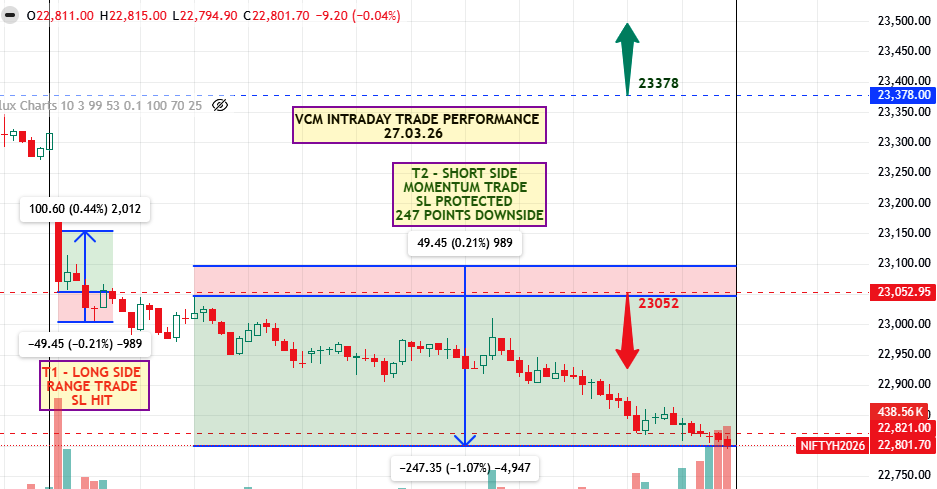
During the session, Nifty Futures presented two clear opportunities based on the predefined vacuum range framework. The market opened within the expected range and initially moved downward, testing the lower boundary around 23052 within the first few minutes of trade.
As per the trading rules, a long-side range trade was initiated near this support zone. However, the price did not sustain, and within a short span, the level was breached. This resulted in the stop-loss being triggered, which is a natural part of any rule-based trading system.
What became crucial at this point was the behavior of price on the lower time frame. The five-minute candles started closing consistently below the same level, indicating that the support had turned weak and sellers were gaining control. This shift in price structure provided a fresh opportunity to initiate a short-side momentum trade.
The second trade aligned perfectly with the emerging trend and delivered a sharp downward move, capturing approximately 247 points on the downside. As a result, even after one stop-loss, the overall intraday outcome remained profitable, supported by a favourable risk-to-reward structure.
This session highlighted an important lesson: losses are part of the process, but disciplined execution and timely adaptation can ensure overall profitability.
Market Overview: Why Did Nifty Fall Sharply?
The broader market on Friday reflected clear signs of stress. The Nifty index declined by around 2.09 percent, erasing most of the gains seen in the previous two sessions. The fall was not limited to index-heavy stocks; it was broad-based and reflected in weak market breadth.
A large number of stocks ended in the red, indicating that selling pressure was widespread rather than concentrated. This kind of breadth usually suggests a risk-off sentiment across the market.
There were three primary reasons behind this sharp decline.
The first was the continued weakness in the Indian rupee, which tends to create discomfort for foreign investors and impacts overall sentiment.
The second and more significant factor was the sharp rise in crude oil prices. Global energy markets reacted strongly to geopolitical developments, pushing prices higher and raising concerns about inflation and economic stability.
The third reason was related to positioning. Being the last trading session of the week, many market participants preferred to reduce exposure and carry lighter positions into the weekend due to uncertainty in global developments.
Global Developments Driving Market Sentiment
Over the last 24 hours, global cues have played a dominant role in shaping market direction.
Tensions between the United States and Iran have escalated further, creating uncertainty across financial markets. This has led to a significant erosion of global wealth and has shifted investor sentiment from growth optimism to inflation concerns.
At the same time, crude oil prices have surged above critical levels due to supply disruptions around the Strait of Hormuz. For an economy like India, which is heavily dependent on oil imports, such a move can have a direct impact on inflation, currency stability, and fiscal balance.
In response to these developments, India has started re-engaging with Russia to secure energy supplies. This indicates a shift towards a more practical and security-driven approach rather than a purely geopolitical stance.
Meanwhile, the broader Middle East conflict continues to remain unresolved. The lack of clarity and frequent conflicting statements from global leaders have reduced market confidence. At this stage, markets are likely to respond more to actual developments on the ground rather than verbal commentary.
Another important aspect is the potential impact on India’s growth outlook. Rising oil prices, coupled with global uncertainty, may put pressure on economic growth while keeping inflation elevated. This creates a challenging environment for policymakers as they try to balance growth and price stability.
Nifty Futures Strategy for Monday, 30 March 2026
The approach for the next trading session remains rooted in discipline, clarity, and risk control. The objective is not to predict the market but to respond to price action in a structured manner.
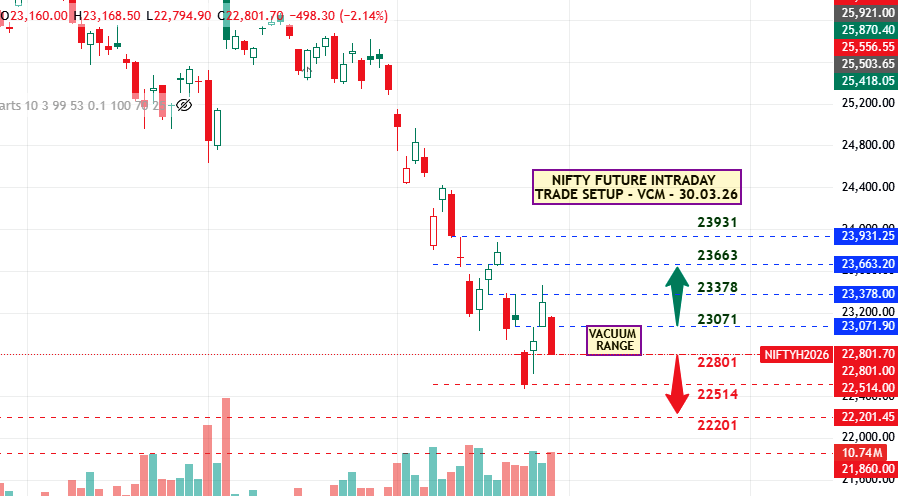
The defined vacuum range for Nifty Futures stands between 23071 on the higher side and 22801 on the lower side.
If the market opens within this range, traders can consider a range-based approach. This means observing which boundary is tested first and then initiating a trade accordingly. If the price moves towards the upper boundary, a short-side trade can be explored, while a move towards the lower boundary can provide a long-side opportunity. In both cases, the focus should remain on strict risk management, with a stop-loss of 50 points and a target of 100 points.
However, markets do not always remain range-bound. If price breaks out of the defined range and sustains beyond it, the strategy should shift towards momentum trading.
If Nifty Futures trades decisively above 23071, it may indicate strength, and a long-side momentum trade can be considered. In such a scenario, resistance levels around 23378 and 23663 can act as potential zones where price may react.
On the other hand, if the market breaks below 22801 and sustains, it may signal weakness, opening the door for a short-side momentum trade. In this case, support levels around 22514 and 22201 become important reference points.
In situations where the market opens with a significant gap outside the defined range, the range trading setup should be avoided completely. Only momentum-based trades should be considered, as gaps often lead to directional moves rather than sideways action.
Risk Management and Execution Discipline
Risk management remains the foundation of this entire approach. Every trade should be taken with a predefined stop-loss and a clear target. The idea is to maintain a minimum risk-to-reward ratio of one to two, which helps in sustaining profitability over a series of trades.
Equally important is limiting the number of trades. Ideally, no more than two trades should be taken in a session. If the first trade achieves its target, it is often better to step aside rather than overtrade in a volatile environment.
Final Perspective
The current market environment is being driven largely by global developments rather than domestic factors alone. This means volatility can remain elevated and price movements can be sharp and unpredictable.
In such conditions, the focus should shift from aggressive trading to controlled execution. Traders who can remain patient, follow their system, and respect risk management rules are more likely to navigate this phase successfully.
Friday’s session demonstrated that even in a difficult market, opportunities exist. The key lies in identifying them with clarity and executing them without emotional bias.
MarkShala – Call to Action
Loved this analysis? Stay ahead in the markets with Markshala’s expert insights. Get deeper market research, trade setups, and investing guidance delivered straight to your inbox.
👉 For collaborations & queries: somnath@markshala.com
👉 WhatsApp Connect: +91 8209177236
Looking to invest in current NFOs or Bonds?
👉 Explore live investment opportunities here: Click Here
Click Here to join our partner Equity / Other Capital Market Investing Platform and unlock MarketShala’s expert-backed investing guidance. You may also join our WhatsApp community MarketShalians to stay tuned with regular updates in your wealth creation journey.
Click Here to join our partner in Crypto Currency Market Investing Platform and unlock MarketShala’s expert-backed investing guidance.
Stay informed. Stay profitable.
– Team Markshala
Disclaimer
The views and analysis provided above are for educational and informational purposes only and should not be considered as financial or investment advice. Trading and investing in the stock market involve risk, and past performance does not guarantee future results.
***********
|| ॐ नमः शिवाय ||