

The Indian stock market continues to pass through a phase of intense volatility. Monday, 16 March 2026, was another session that clearly reflected how uncertain market sentiment currently is. Sharp intraday swings, sudden momentum bursts, and uneven participation across stocks remained the defining features of the day.
In this article, we will review the intraday trading behaviour of Nifty Futures, analyse the overall market structure, and discuss a rule-based trading framework for the next session on Tuesday, 17 March 2026. The objective of this analysis is not to predict the market but to interpret price behaviour and prepare for different possible scenarios with discipline and clarity.
Intraday Trade Review – Nifty Futures (16 March 2026)
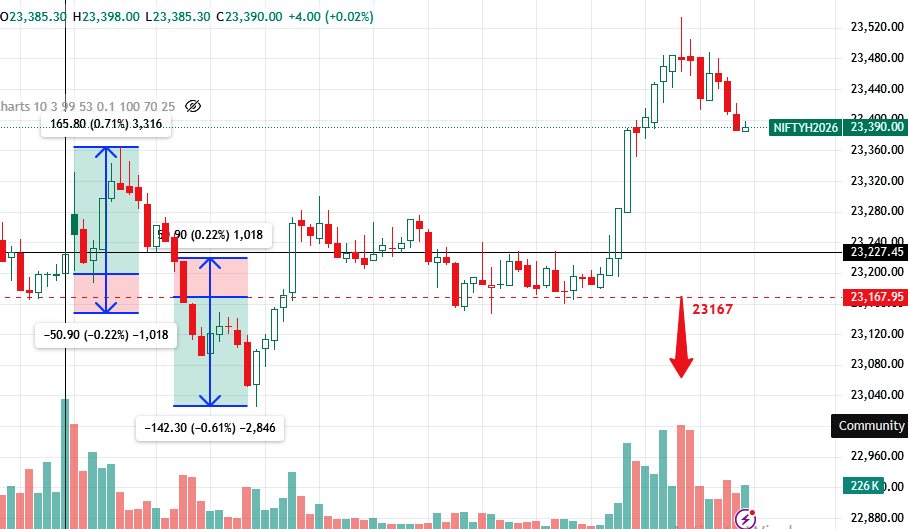
In the previous session, the trading levels that had been defined in advance for Nifty Futures turned out to be quite relevant in terms of price action.
The market opened very close to the lower boundary of the vacuum range near 23167. According to the range-trading framework discussed earlier, this zone was expected to act as a reaction level. Initially, the range trade experienced a stop-loss trigger, which is a normal part of any disciplined trading system.
However, once the market broke below this lower boundary, the structure shifted from a range environment to a momentum environment. At that point, a short-side momentum trade was activated. Traders who followed the momentum structure were able to capture a downside move of approximately 142 points, which demonstrated the effectiveness of adapting to changing market conditions.
Interestingly, another perspective of the same price zone also produced a profitable outcome. Traders who interpreted 23167 as an intraday support level during the first few minutes of the session and initiated a long trade were able to witness an upward move of nearly 165 points during the recovery phase.
This dual possibility once again highlights an important truth about markets. Price levels are not predictions; they are reference points. The outcome depends entirely on how traders interpret the behaviour of price around those zones.
Nifty Market Overview – 16 March 2026
By the end of the session, Nifty Spot closed at 23,408, registering a gain of approximately 1.11 percent for the day. At first glance, this may appear to be a sign of strength, but a deeper analysis suggests that the situation is not so straightforward.
After experiencing a significant correction over the past several sessions, a single day of upward movement does not necessarily indicate a structural reversal. In fact, the Nifty index is still trading more than eleven percent below its recent highs, which reflects the extent of the decline that has already taken place.
Just a few sessions ago, the market environment was even more stressful for investors. Many portfolios have gone through sharp drawdowns, and for several participants this phase is beginning to resemble the early signs of a bear market.
However, financial markets often behave in ways that challenge immediate perceptions. What appears to be a clear trend at one moment can later reveal itself to be part of a larger consolidation process.
A closer look at the advance–decline ratio of the broader market provides additional insight into today’s price action. While the Nifty index managed to close in positive territory, the broader market did not share the same strength.
During the session, 964 stocks closed higher, whereas 2040 stocks ended the day in negative territory. This imbalance suggests that the recovery was largely concentrated in the index itself rather than being supported by widespread buying across the market.
In other words, the broader market continues to remain under pressure even though the headline index displayed a short-term bounce.
Perspective for Long-Term Investors
For investors who are feeling uncomfortable because of the recent market decline, it is important to step back and consider the broader context.
Financial markets have always experienced cycles driven by economic changes, geopolitical developments, and shifts in investor sentiment. These cycles may feel intense in the moment, but they are rarely permanent.
Even powerful political figures such as Donald Trump or global conflicts cannot dictate the direction of markets indefinitely. Over long periods of time, markets have consistently demonstrated their ability to recover and grow alongside economic progress.
Instead of reacting emotionally during periods of volatility, long-term investors may find it more productive to view such corrections as opportunities. Gradual investments in fundamentally strong companies or disciplined allocations through systematic investment plans in mutual funds can help build wealth over time.
Selling quality assets in panic often leads to regret once market conditions eventually stabilize.
Current Technical Structure of Nifty
At the present moment, the market is still in a phase where clear technical patterns have not yet fully formed. Because of the recent volatility, discussing precise support or resistance levels may not provide much practical value until the market begins to stabilise and create identifiable structures on the chart.
One observation from the current session is nevertheless worth noting. After witnessing extreme volatility and even breaking the previous day’s low levels during the day, the market managed to stage a recovery into the close.
Whether this recovery represents the beginning of a broader stabilisation or merely a temporary reaction remains uncertain. Only the coming sessions will reveal whether the market is preparing for consolidation or another directional move.
Nifty Futures Trading Strategy for Tuesday, 17 March 2026
The trading framework that will be followed for the next session is built on a structured and disciplined approach. The objective of this framework is not to increase the number of trades but to maintain emotional balance, protect capital, and participate only when the probability structure becomes favourable.
One of the most important principles in trading is the ability to limit activity rather than increase it unnecessarily. Therefore, the framework suggests that traders should ideally take no more than two trades during a session. These two trades may include one range-based trade and one momentum-based trade.
If the first trade itself reaches the predefined target, it is often wiser to step away from the market for the remainder of the session rather than continuing to search for additional opportunities.
Range Trading Framework
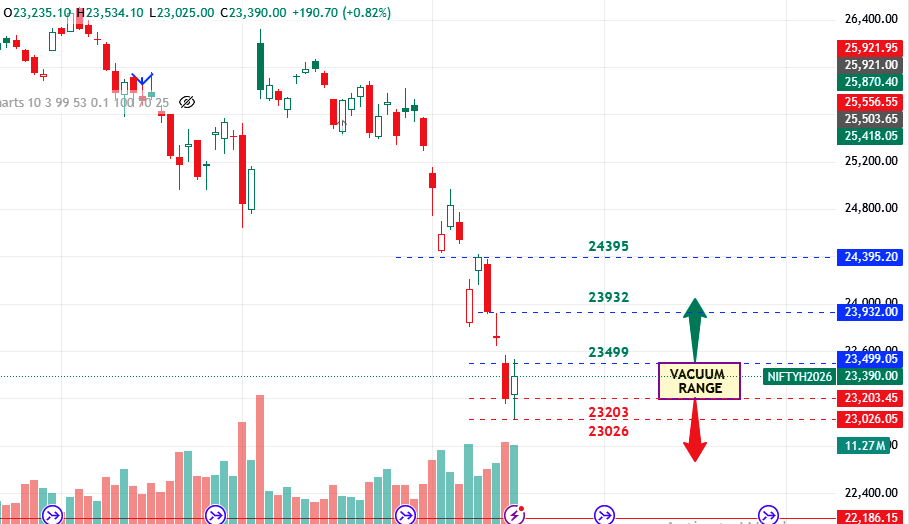
If Nifty Futures opens within the predefined vacuum range of 23,499 to 23,203, traders may observe the behaviour of price within this zone before initiating any position.
The key principle here is patience. Instead of anticipating a move, traders should wait to see which boundary of the range the market approaches first.
If the price action moves toward the upper boundary of the range near 23,499, a short-side range trade may be considered. Conversely, if the market first tests the lower boundary near 23,203, traders may consider a long-side range trade.
For both scenarios, the trading structure remains the same. The stop-loss is limited to 50 points, while the minimum target remains 100 points, ensuring that the risk-to-reward ratio stays favourable.
Momentum Trading Opportunities
In certain situations, markets move with sufficient strength to break out of defined ranges. When this happens, the trading approach should shift from range-based decisions to momentum-based participation.
If Nifty Futures begins to trade decisively above 23,499, the market may enter a bullish momentum phase. Under such circumstances, a long momentum trade may be considered with a disciplined stop-loss of fifty points and a minimum target of one hundred points.
In such a scenario, the next significant resistance zones on the chart may appear near 23,932 and later around 24,395.
On the other hand, if Nifty Futures breaks decisively below 23,203, the market may shift into a bearish momentum phase. A short-side trade may then be considered under the same risk management parameters. In this case, the market may encounter support zones around 23,026 and later near 22,186.
Gap Opening Scenario
Sometimes the market opens with a significant gap due to overnight global developments. If Nifty Futures opens outside the defined vacuum range, the range-trading setup automatically becomes invalid for that session. In such cases, traders should avoid forcing trades near arbitrary levels and instead focus only on clear momentum structures that emerge during the session.
Global and Economic Developments in the Last 24 Hours
The broader market environment continues to be influenced by several global economic and geopolitical developments.
Tensions in the Middle East have intensified as the conflict involving the United States, Israel, and Iran continues to evolve. These developments have pushed global crude oil prices higher, with Brent crude trading above the hundred-dollar mark. Rising energy prices increase inflation risks and create additional pressure on economies that depend heavily on energy imports.
Another development comes from India’s external trade data. The country’s merchandise trade deficit narrowed to approximately twenty-seven billion dollars in February. Imports declined while exports showed modest improvement. However, the ongoing geopolitical tensions in the Middle East may still affect shipping routes and energy supplies in the coming weeks.
Currency markets have also reacted to these global developments. The Indian rupee recently weakened to levels close to ninety-two against the US dollar, reflecting both rising oil prices and foreign capital outflows from emerging markets.
Meanwhile, economic data released by China indicates stronger-than-expected industrial production growth, supported largely by infrastructure spending and technology exports. Although this development supports global manufacturing demand, concerns about consumer demand in China remain.
In the Indian corporate landscape, the fintech company PhonePe has decided to delay its planned public listing due to volatile market conditions. The decision reflects the cautious sentiment currently prevailing in global capital markets.
Concluding Thoughts
The present market environment is clearly characterised by volatility and uncertainty. For traders, this means that discipline and risk management become even more important than directional predictions.
For investors, history suggests that market corrections often provide opportunities rather than permanent setbacks. Markets will eventually stabilise, new trends will emerge, and fresh opportunities will appear. Until then, patience, discipline, and a clear strategy remain the most valuable tools for navigating uncertain times.
MarkShala – Call to Action
Loved this analysis? Stay ahead in the markets with Markshala’s expert insights. Get deeper market research, trade setups, and investing guidance delivered straight to your inbox.
👉 For collaborations & queries: somnath@markshala.com
👉 WhatsApp Connect: +91 8209177236
Looking to invest in current NFOs or Bonds?
👉 Explore live investment opportunities here: Click Here
Click Here to join our partner Equity / Other Capital Market Investing Platform and unlock MarketShala’s expert-backed investing guidance. You may also join our WhatsApp community MarketShalians to stay tuned with regular updates in your wealth creation journey.
Click Here to join our partner in Crypto Currency Market Investing Platform and unlock MarketShala’s expert-backed investing guidance.
Stay informed. Stay profitable.
– Team Markshala
Disclaimer
The views and analysis provided above are for educational and informational purposes only and should not be considered as financial or investment advice. Trading and investing in the stock market involve risk, and past performance does not guarantee future results.
***********
|| ॐ नमः शिवाय ||