

The Indian equity market continued to show constructive strength on Friday, 10 April 2026, supported by positive global cues and improving sentiment across sectors. While the broader market delivered a solid upward move during the session, the day also offered an important lesson for traders who follow systematic intraday trading frameworks.
For professional traders, every trading session is not only about profit and loss but also about discipline, risk management, and consistent execution of a strategy. In today’s market activity, the VCM Intraday Trade Setup experienced a challenging session, even though the broader market structure remained strong.
In this detailed market note, we will review the trading activity observed during today’s session, analyse the technical structure of the Nifty50 index, and discuss a structured trading framework for Nifty Futures for the next trading session on Monday, 13 April 2026. We will also highlight some important geopolitical and macroeconomic developments from the last 24 hours that may continue to influence market sentiment in the coming sessions.
Today’s Trades: A Practical Lesson in Trading Discipline
In the VCM Intraday Trade Setup, today’s session presented a situation that every systematic trader must eventually face.
Over the previous trading sessions, the setup had either delivered a series of successful trades or had clearly identified no-trade days where market conditions did not align with the strategy. However, the current session produced a different type of outcome—one that tests the emotional discipline of traders.
Such situations are completely normal in any rule-based trading system. In fact, if a trading strategy never experiences losing trades, it is often a signal that the system is either unrealistic or not being executed correctly.
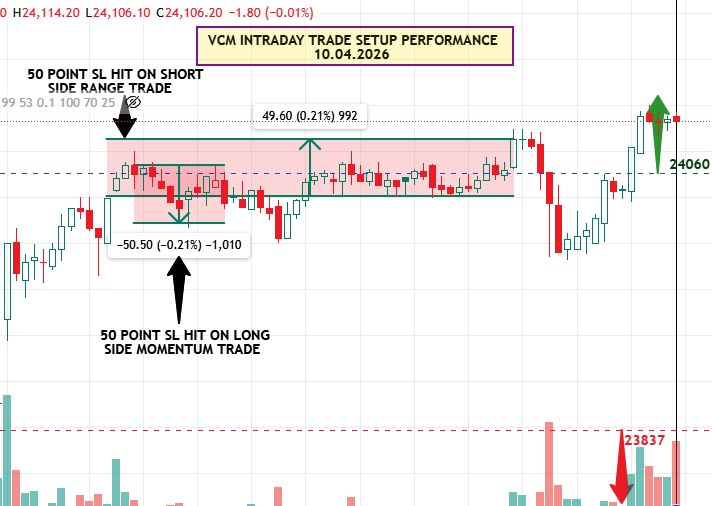
During today’s session, the setup generated two valid trading opportunities, both based on the predefined vacuum range structure.
The first opportunity emerged when Nifty Futures approached the upper boundary of the vacuum range near 24060, where the strategy allowed for a short-side range trade. According to the trading rules, this trade was initiated with a predefined stop loss and target.
However, the market did not move in favour of the trade and gradually moved in the opposite direction.
As the price moved decisively above the upper boundary of 24060, the trading framework then activated a long-side momentum trade, which is part of the adaptive nature of the strategy. This second trade was intended to capture a potential breakout move in the direction of the market momentum.
Interestingly, the market reversed again after triggering the momentum trade, eventually hitting the predefined stop loss of 50 points.
As a result, both trades for the session ended with stop losses.
This is precisely the moment where professional discipline becomes more important than prediction. A systematic trader simply follows the trading rules, accepts the outcome, and closes the trading terminal for the day after completing the allowed number of trades.
There is no emotional reaction, no attempt to recover losses through impulsive trades, and no regret.
It is also important to note that the VCM Trade Setup has historically demonstrated a winning probability of over 70 percent based on past observations. The purpose of sharing these trades daily is to present transparent, practical execution of the strategy using real market conditions and actual numbers.
To further strengthen this transparency, we are currently maintaining a detailed performance tracker for the VCM trading framework. As more data accumulates, we will periodically share additional insights such as the overall winning ratio, profit consistency, and the behaviour of the system under different market conditions.
Therefore, while today’s session may have been challenging from the perspective of the trading setup, it should be viewed as a normal statistical occurrence within a disciplined trading system rather than an abnormal event.
Market Action on 10 April 2026: Nifty Maintains Positive Momentum
From a broader market perspective, Friday’s session was clearly positive for the Indian equity market.
The Nifty50 index closed with a gain of approximately 1.16 percent, reflecting sustained buying interest throughout the day.
The session began with a gap-up opening, largely influenced by supportive global market signals. After the initial opening, the market maintained a constructive tone for most of the trading session, with limited signs of aggressive selling pressure.
Market breadth also remained positive, suggesting that the upward movement was supported by participation from a wider range of stocks rather than being limited to a few large index constituents.
From a technical perspective, several indicators suggest that the market is gradually strengthening.
The Relative Strength Index (RSI) continues to remain above the 50 level, which generally indicates that bullish momentum is gradually building in the market.
Another important observation on the daily chart is the formation of a higher-high structure, which often reflects improving market confidence and the possibility of a gradual trend recovery after a corrective phase.
At the same time, the index is slowly building stronger support zones below current levels.
Two important support levels that traders may watch in the coming sessions are 23782 and 23515. These levels could potentially act as technical cushions if the market experiences temporary corrective moves.
Key Technical Hurdles Still Exist
Despite the positive tone in the market, certain technical barriers remain ahead.
At present, the 50-day, 100-day, and 200-day Exponential Moving Averages are still positioned above the current level of the Nifty index. Until the index manages to cross these levels convincingly, they may continue to act as resistance zones.
Another important aspect to consider is that a significant portion of the recent upward movement has been driven by a technical recovery from oversold conditions.
For the market to sustain a strong upward trend over the medium term, fundamental support in the form of earnings growth, macroeconomic stability, and corporate performance will be necessary.
If these factors align with improving technical structure, the market could potentially move toward the next phase of a broader bullish trend.
Trading Framework for Nifty Futures: Session of 13 April 2026
The following trading framework is based on a rule-based approach that prioritizes discipline, risk control, and clarity of execution.
The objective of the framework is not to predict market direction but to respond to market behaviour with predefined risk parameters.
Core Trading Approach
One of the key principles of this trading framework is to limit the number of trades during the session.
Ideally, a trader should take no more than two trades in a single trading day.
These two trades typically consist of:
one range-based trade and
one momentum-based trade.
If the first trade itself reaches the predefined target, it is often advisable to avoid initiating any additional trades during the session. This approach helps maintain psychological discipline and prevents overtrading, which can significantly affect long-term trading consistency.
Range Trade Setup for 13 April 2026
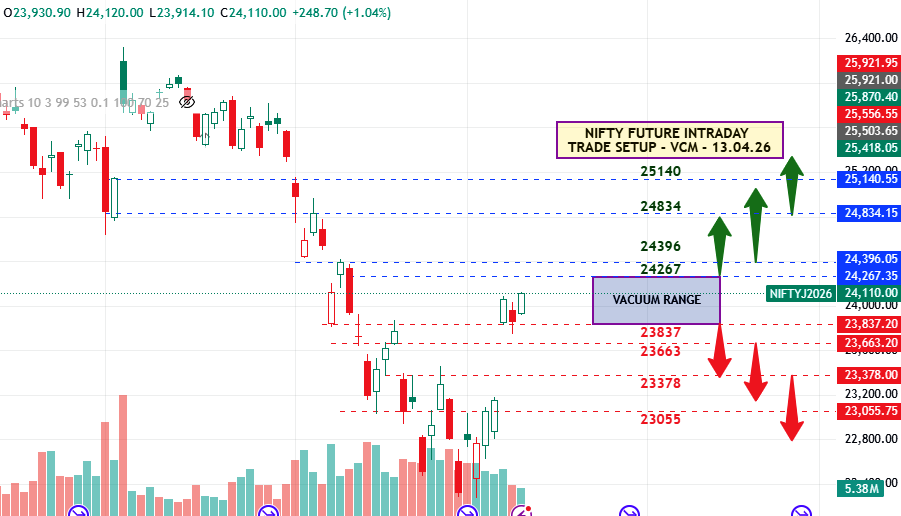
For the next trading session, the vacuum range for Nifty Futures is identified between 24267 and 23837.
If Nifty Futures opens within this range, traders may observe which side of the range is tested first.
If the price approaches the upper boundary near 24267, a short-side range trade may be considered based on price behaviour.
Similarly, if the price moves toward the lower boundary near 23837, a long-side range trade may be considered.
In both cases, the predefined risk parameters remain the same.
The stop loss for the trade may be limited to 50 points, while the expected minimum target may be around 100 points, maintaining a risk-reward framework of approximately 1:2.
Long Momentum Trade Scenario
If the market shows strong buying momentum and Nifty Futures begins to trade decisively above 24267, the strategy may shift from range trading to a momentum-based approach.
In such a situation, a long-side momentum trade may be considered with a 50-point stop loss and a minimum target of 100 points.
In this scenario, the next technical zones that market participants may observe are resistance levels near 24396 and 24834.
Short Momentum Trade Scenario
On the other hand, if the market weakens and Nifty Futures trades decisively below 23837, a short-side momentum trade may be considered within the same disciplined framework.
The stop loss may again be maintained at 50 points, while the minimum target may remain around 100 points.
If such a move develops, the next technical zones that traders may monitor are support levels near 23663 and 23378.
Key Global Developments in the Last 24 Hours
Alongside technical factors, global macroeconomic developments continue to influence market sentiment.
One important development has been reports suggesting the possibility of reduced tensions between Iran and the United States, which has slightly improved risk sentiment across Asian markets. Reduced geopolitical stress often helps stabilize energy markets and improves investor confidence.
Another positive development for the Indian economy came from the Asian Development Bank, which recently upgraded India’s economic growth projection to 6.9 percent for FY2026, highlighting strong domestic demand and favourable economic momentum.
At the geopolitical level, discussions between India and the United States have continued to deepen cooperation in areas such as technology, artificial intelligence, and critical supply chains. These developments could have long-term strategic implications for economic growth.
Meanwhile, the Reserve Bank of India has been observed taking measures to stabilize the Indian rupee amid global volatility and concerns related to foreign capital flows.
Finally, the International Monetary Fund has indicated that ongoing geopolitical conflicts could potentially create demand for large financial assistance packages, highlighting the broader economic risks associated with prolonged global tensions.
Concluding Perspective
The market environment continues to present both opportunities and uncertainties.
While the recent price action suggests that technical recovery is underway, several macroeconomic and geopolitical variables remain active in the background. Traders and investors may therefore benefit from maintaining a balanced approach that combines technical awareness, disciplined risk management, and careful observation of global developments. As always, trading frameworks should be viewed as structured analytical tools rather than guarantees of market outcomes, and market participants should adapt their strategies according to their individual risk tolerance and financial objectives.
MarkShala – Call to Action
Loved this analysis? Stay ahead in the markets with Markshala’s expert insights. Get deeper market research, trade setups, and investing guidance delivered straight to your inbox.
👉 For collaborations & queries: somnath@markshala.com
👉 WhatsApp Connect: +91 8209177236
Looking to invest in current NFOs or Bonds?
👉 Explore live investment opportunities here: Click Here
Click Here to join our partner Equity / Other Capital Market Investing Platform and unlock MarketShala’s expert-backed investing guidance. You may also join our WhatsApp community MarketShalians to stay tuned with regular updates in your wealth creation journey.
Click Here to join our partner in Crypto Currency Market Investing Platform and unlock MarketShala’s expert-backed investing guidance.
Stay informed. Stay profitable.
– Team Markshala
Disclaimer
The views and analysis provided above are for educational and informational purposes only and should not be considered as financial or investment advice. Trading and investing in the stock market involve risk, and past performance does not guarantee future results.
***********
|| ॐ नमः शिवाय ||