

The Indian equity market continued to display a mixture of opportunity and caution on Thursday, 9 April 2026. Despite the presence of global uncertainties and some degree of profit booking after the previous day’s rally, disciplined traders still found meaningful opportunities through structured trading setups in Nifty Futures.
In this market commentary, we review today’s intraday trade opportunities in Nifty Futures, analyze the broader market environment, and discuss a rule-based trading framework for the next session, Friday, 10 April 2026. The objective of this analysis is purely educational and is intended to help traders understand how structured decision-making can help maintain discipline in volatile market conditions.
Intraday Trade Review: Nifty Futures – 9 April 2026
The VCM Intraday Trading Setup, which focuses on identifying high-probability trades within predefined price zones, once again presented clear opportunities during today’s session.
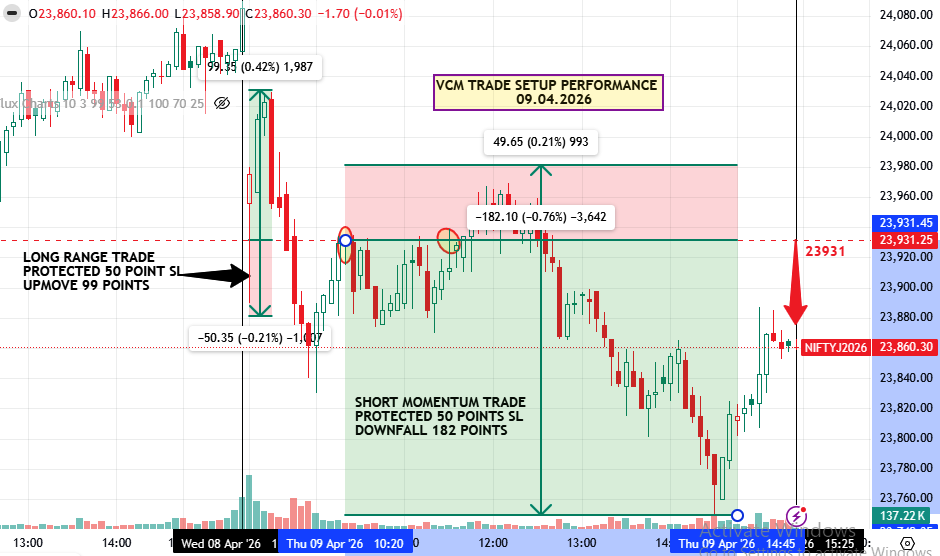
At the opening bell, Nifty Futures began trading within the predefined vacuum range. Within the very first five minutes of market activity, the index moved lower and tested the vacuum range lower boundary near 23931.
According to the rule-based framework, whenever the market tests the lower boundary of the range first, it creates a potential long-side range trading opportunity. Based on this principle, a long trade was initiated near that level with a strict protective stop loss of 50 points, while the system target remained 100 points.
Following the entry, the market responded positively and moved upward. During this phase, Nifty Futures rallied by approximately 99 points from the entry zone.
At this point, traders may interpret the situation differently. Some market participants may argue that a move of 99 points versus the intended 100-point target makes practically no difference from a profit-booking perspective. Others may point out that since the system target was exactly placed at 100 points, the trade might not have been automatically closed if the price fell short by a single point.
Both viewpoints deserve respect because trading psychology differs from person to person. However, it is equally important to remember that the long-term success of any trading system depends not only on rules but also on practical execution and adaptability. If a trader repeatedly misses profit booking due to rigid expectations, it often signals that further refinement in execution skills may be beneficial.
Let us assume the second scenario where the trade did not close at 99 points and eventually the protective stop loss of 50 points was triggered as the market reversed.
Even in such a situation, the trading framework allows traders to participate in the next valid opportunity if the market structure confirms a fresh setup.
That is exactly what happened today.
After moving lower, Nifty Futures broke below the 23931 level decisively. Later, the index returned to this level and performed a technical retest, which confirmed weakness in the short-term price structure.
Such retests often provide an opportunity for momentum-based short trades.
On the five-minute intraday chart, once the price started trading below 23931 again, a short momentum trade was triggered. The same disciplined risk management rule was followed, maintaining a 50-point stop loss.
From that point onward, the market witnessed strong downward momentum. Eventually, Nifty Futures declined nearly 182 points, comfortably achieving the minimum expected target of 100 points.
As a result, even though the first trade presented execution challenges, the structured trading framework ultimately helped the session conclude with a net positive outcome.
Market Overview – 9 April 2026
The broader market environment today reflected a phase of mild consolidation and cautious sentiment.
After witnessing strong upward momentum in the previous trading session, the market experienced some degree of profit booking, which is a natural process following sharp rallies.
However, domestic factors were not the only reason behind the cautious mood. Global developments also played an important role in shaping investor sentiment.
In recent days, attention has been focused on developments related to the West Asia geopolitical situation. Although a temporary ceasefire framework had been discussed earlier, recent developments suggest that both sides involved in the conflict are still navigating complex negotiations. This has resulted in a certain level of uncertainty across global financial markets.
Such developments are not unusual. Historically, while conflicts may escalate rapidly, bringing them to a stable and permanent resolution usually requires sustained diplomatic effort and time.
Investors around the world continue to hope that a long-term peaceful resolution will eventually emerge, but until that clarity arrives, financial markets are likely to remain somewhat sensitive to geopolitical news.
Reflecting this cautious sentiment, the Nifty 50 Spot Index declined approximately 0.93 percent during the session.
Interestingly, despite the headline index decline, overall market breadth remained reasonably balanced, primarily because several mid-cap and small-cap stocks continued to show relative resilience.
Volatility indicators also signaled a slightly cautious environment. The India VIX moved higher and closed near the 20.42 level, suggesting that traders are pricing in a degree of uncertainty in the near term.
The currency market also reflected similar caution. The Indian Rupee weakened and traded around 92.63 against the US dollar, which is partly linked to global risk sentiment and capital flows.
Energy markets were also active. Due to geopolitical concerns, Brent crude oil prices moved higher and were seen trading around $98.67 per barrel.
Taken together, these indicators suggest that while the broader market structure remains stable, investors and traders are currently adopting a more careful approach.
From a technical standpoint, one important level to monitor in the coming sessions is the 20-day exponential moving average, which is currently positioned near 23459. This level is likely to act as a meaningful support zone for the market.
Another positive technical observation is that the Relative Strength Index (RSI) continues to remain above the 50 mark, indicating that the broader trend has not yet lost its underlying strength.
The next session will be particularly interesting because it will be the last trading day before the weekend, and market participants will closely observe how the index behaves before entering the two-day break.
Trading Strategy for Nifty Futures – Friday, 10 April 2026
The trading approach discussed here is based on a disciplined, rule-based framework designed to manage risk and maintain emotional balance during intraday trading.
The objective is not to predict the market but to respond to price behaviour in a structured manner.
One of the most important aspects of this framework is limiting the number of trades. Ideally, traders should avoid excessive activity and restrict themselves to a maximum of two trades during the session.
These may include one range-based trade and, if necessary, one momentum-based trade.
If the first trade itself achieves its objective, it is often wiser to avoid taking additional trades, as this helps prevent overtrading and protects psychological discipline.
Range Trading Setup
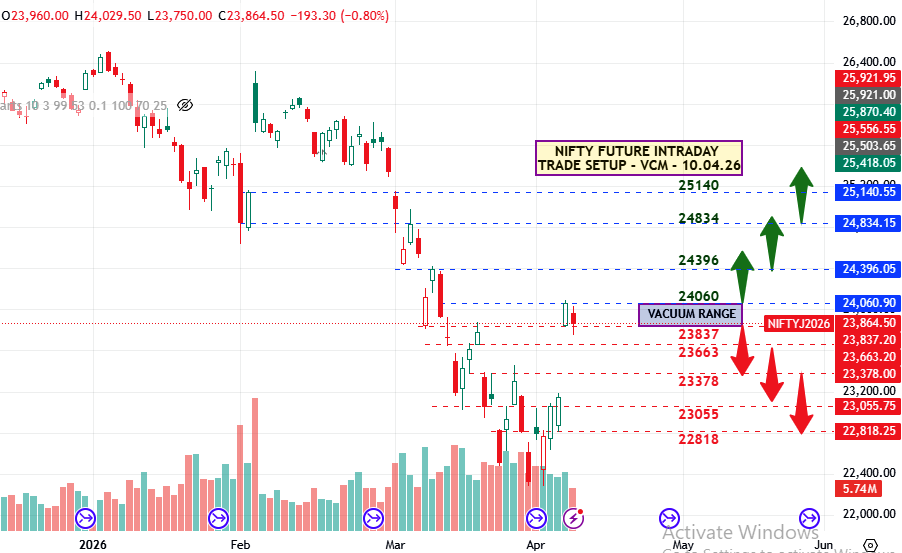
For the upcoming session, the vacuum range for Nifty Futures is identified between 24060 and 23837.
If the market opens within this zone, traders may observe which side of the range is tested first.
If the price approaches the upper boundary near 24060, the setup may create a potential short-side range trade.
On the other hand, if the market tests the lower boundary near 23837, it may provide a potential long-side range trade opportunity.
In both cases, the framework maintains the same discipline: a stop loss of 50 points and a minimum expected target of 100 points.
Momentum Trading Setup
Momentum trades become relevant when the market breaks out of the predefined range with conviction.
If Nifty Futures moves decisively above 24060, it may signal strengthening bullish momentum. Under such circumstances, traders may consider a long-side momentum trade while maintaining a 50-point stop loss and targeting at least 100 points on the upside.
In such a scenario, the market may encounter resistance zones near 24396 and later around 24834.
Conversely, if Nifty Futures trades decisively below 23837, it may indicate bearish momentum in the short term. This situation may create an opportunity for a short-side momentum trade, again following the same disciplined risk parameters.
On the downside, potential support levels may appear near 23663, followed by a deeper support region around 23378.
Global Developments in the Last 24 Hours
Several geopolitical and macroeconomic developments have influenced market sentiment during the past 24 hours.
One of the major factors has been the renewed uncertainty surrounding the fragile ceasefire discussions linked to the United States and Iran, which has pushed Brent crude oil prices closer to the $97–$99 per barrel range. Higher crude prices often raise concerns about inflation and can impact equity markets worldwide.
In response to these developments, India’s Petroleum Minister Hardeep Singh Puri has initiated diplomatic discussions with Qatar, aimed at ensuring stability in India’s energy supply chain. Considering that India imports a significant portion of its crude oil requirements, such engagements play an important role during periods of geopolitical tension.
Meanwhile, the World Bank has projected India’s GDP growth for FY2027 at approximately 6.6 percent, although it has cautioned that rising energy prices and global uncertainty could present challenges. Inflation expectations remain close to 4.9 percent, while foreign investor outflows and currency fluctuations continue to be monitored closely.
Currency markets have also shown sensitivity to geopolitical developments, as investors evaluate the stability of the ceasefire environment. During such phases, safe-haven assets such as gold often attract attention.
Another strategic development relates to the strengthening relationship between India and Australia. Discussions regarding an upcoming diplomatic engagement later this year highlight the continued expansion of cooperation in areas such as trade, defense, and Indo-Pacific regional strategy.
Concluding Perspective
The current market environment demonstrates that opportunities and risks often coexist in financial markets.
While technical indicators continue to show constructive characteristics, geopolitical developments and global economic factors are creating intermittent phases of volatility.
In such conditions, the most effective approach for traders is to rely on structured decision-making, disciplined execution, and prudent risk management. By focusing on process rather than prediction, market participants can navigate uncertainty with greater clarity and consistency.
MarkShala – Call to Action
Loved this analysis? Stay ahead in the markets with Markshala’s expert insights. Get deeper market research, trade setups, and investing guidance delivered straight to your inbox.
👉 For collaborations & queries: somnath@markshala.com
👉 WhatsApp Connect: +91 8209177236
Looking to invest in current NFOs or Bonds?
👉 Explore live investment opportunities here: Click Here
Click Here to join our partner Equity / Other Capital Market Investing Platform and unlock MarketShala’s expert-backed investing guidance. You may also join our WhatsApp community MarketShalians to stay tuned with regular updates in your wealth creation journey.
Click Here to join our partner in Crypto Currency Market Investing Platform and unlock MarketShala’s expert-backed investing guidance.
Stay informed. Stay profitable.
– Team Markshala
Disclaimer
The views and analysis provided above are for educational and informational purposes only and should not be considered as financial or investment advice. Trading and investing in the stock market involve risk, and past performance does not guarantee future results.
***********
|| ॐ नमः शिवाय ||