

The Indian equity markets witnessed a powerful recovery on Wednesday, 08 April 2026, bringing relief to investors who had been dealing with significant volatility over the past several weeks. After a phase dominated by geopolitical uncertainty and nervous global sentiment, the markets finally responded to improving global developments with a sharp upward move.
For market participants, days like these often serve as reminders of an old market saying: sometimes a single decisive move can outweigh many smaller fluctuations. That sentiment was clearly visible in today’s trading session, where optimism returned across global markets and was reflected strongly in Indian equities as well.
In this article, we review the intraday behaviour of Nifty Futures, analyse the broader market environment, and outline a structured technical framework for the next trading session on Thursday, 09 April 2026.
Intraday Review: Nifty Futures on 08 April 2026
Before discussing the performance of the VCM Intraday Trade Strategy, it is important to recognise the nature of today’s session. The market movement was largely driven by global developments and sentiment shifts, making it a day that rewarded patient investors more than active intraday traders.
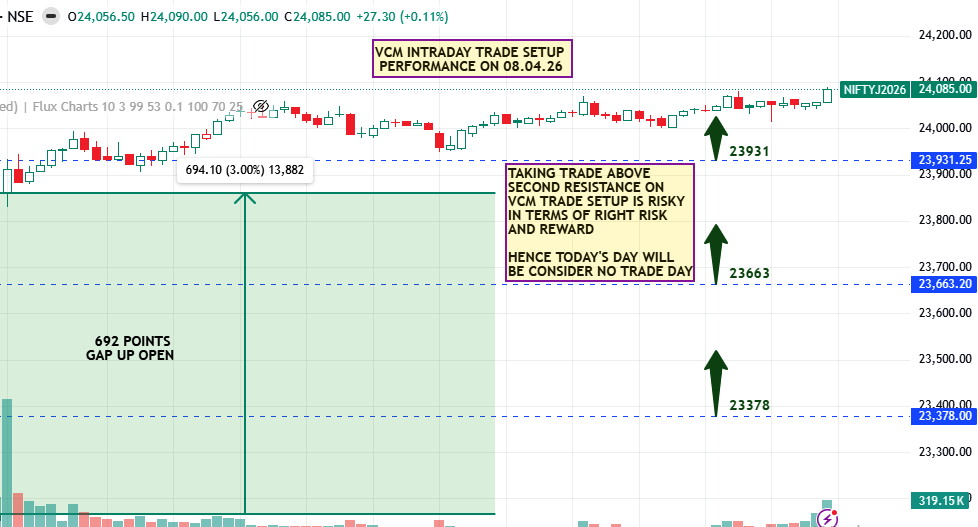
The trading session began with an exceptionally strong gap-up opening in Nifty Futures, with the index opening nearly 692 points higher than the previous close. Such a large gap-up immediately altered the technical landscape that traders had been observing earlier.
The previously discussed technical zones quickly lost relevance because the index opened significantly above them. The upper boundary of the Vacuum Range near 23378 and the first resistance around 23663 were both crossed even before the market began regular intraday trading.
At the time of opening, Nifty Futures was already trading close to the second resistance level near 23931.
From a purely technical perspective, one possible scenario could have emerged if the market had shown some intraday retracement after the gap-up opening. In that case, a move back toward the first resistance zone, which could then act as support, might have provided an opportunity for a controlled momentum trade on the long side within the VCM framework.
However, the market had different plans.
Instead of correcting, the index continued to display considerable strength. Nifty Futures moved higher and decisively crossed the second resistance level of 23931, continuing to trade above it for most of the session.
While this move certainly confirmed bullish momentum, the VCM trading framework emphasises discipline over excitement. According to the strategy guidelines, initiating a trade significantly above the second resistance level—especially when the market has already opened far above the previous day’s closing range—introduces unnecessary risk.
Therefore, rather than forcing a trade under unfavourable conditions, the session was treated as a “no-trade day” within the strategy framework.
In trading, maintaining discipline is often more important than participating in every market move. Preserving capital and following predefined rules remain essential elements of a sustainable trading approach.
Market Overview: What Drove Today’s Rally
The strong rally in Indian equities did not occur in isolation. It was part of a broader global reaction to developments in the geopolitical environment, particularly related to tensions in West Asia.
Over the past few days, global markets had been closely monitoring escalating rhetoric and deadlines associated with a potential military escalation involving Iran. These developments had created significant uncertainty in global financial markets.
A key deadline that had been widely discussed in the international media was scheduled around 05:30 AM Indian Standard Time, raising concerns about the possibility of a major military action.
However, rather than an escalation, markets received an unexpected but welcome development.
Reports suggested that the deadline was extended and a temporary two-week ceasefire was announced, providing immediate relief to financial markets worldwide. The ceasefire is believed to have been facilitated through diplomatic mediation, with regional players reportedly contributing to the negotiation process.
Although detailed terms and long-term implications of this arrangement are yet to be fully clarified, the announcement alone was enough to trigger a global risk-on sentiment.
Equity markets across Asia and other regions reacted positively, and Indian markets followed the same trend.
Performance of the Indian Market
Reflecting the improvement in global sentiment, the Nifty 50 spot index closed the session with a strong gain of approximately 3.78 percent.
This sharp rise represented one of the most significant single-day recoveries seen in recent weeks.
An additional technical development worth noting is that the Nifty 50 managed to close above its 20-day Exponential Moving Average (20-DEMA). For several trading sessions, this moving average had acted as a resistance level where upward attempts were being rejected.
A close above this level may indicate that short-term sentiment is gradually shifting in favour of the bulls, although confirmation will depend on how the market behaves in the coming sessions.
It remains important for market participants to continue monitoring geopolitical developments, as global headlines have recently demonstrated their ability to influence market direction in a meaningful way.
Behaviour of Key Market Indicators
Apart from equity prices, several other indicators also reflected the improvement in sentiment.
The Indian Rupee strengthened during the session, trading around 92.32 against the US Dollar, indicating a modest improvement in confidence toward emerging markets.
At the same time, the India VIX index declined sharply by more than 20 percent and moved near 19.69. A drop in volatility generally suggests that immediate fear in the market has reduced, although volatility levels remain elevated compared with long-term averages.
Another notable development was seen in energy markets. Crude oil prices experienced a significant decline, with prices falling to approximately 93.90 dollars per barrel, representing a drop of more than nine percent.
For an oil-importing economy like India, declining crude prices are generally considered supportive for macroeconomic stability because they reduce inflationary pressure and improve the country’s external balance.
Market Breadth and Investor Sentiment
Over the past three trading sessions, market breadth has been steadily improving, and today’s rally further strengthened this trend.
Many investors who had been experiencing sharp drawdowns in their portfolios during the earlier correction phase witnessed a noticeable recovery in portfolio values.
Nevertheless, it is important to maintain perspective.
Despite the recent recovery, the Nifty 50 index still remains roughly nine percent below its previous peak levels. As a result, many retail portfolios that hold individual stocks may still be facing substantial unrealised losses.
The last few sessions have certainly provided psychological relief, but a complete recovery across broader portfolios may require additional time and sustained market stability.
Even so, the improvement in sentiment seen recently has helped restore confidence among market participants.
Nifty Futures Trading Framework for 09 April 2026
The approach used for analysing Nifty Futures remains based on a structured and disciplined framework. The emphasis is on maintaining emotional balance, limiting unnecessary trading activity, and focusing on clear technical conditions before initiating any position.
Under this approach, it is generally preferable to limit the number of trades during the session. Ideally, traders should avoid taking more than two trades during the day.
In many situations, if the first trade reaches its predefined target, stepping away from further trading may help maintain discipline and prevent over-trading.
Range Trading Framework
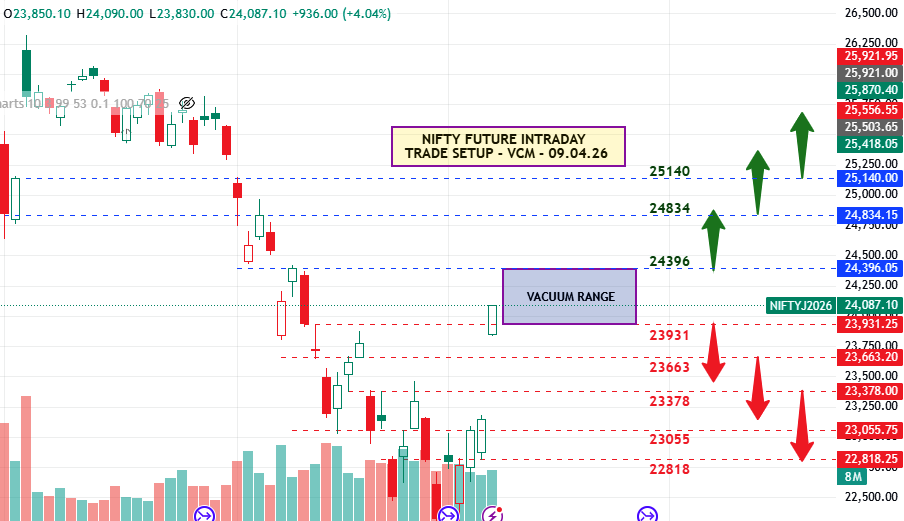
For the session of Thursday, 09 April 2026, a potential trading range has been identified between 24396 and 23931 in Nifty Futures.
If the market opens within this range, traders may observe how price behaves when approaching either boundary.
A movement toward the upper boundary near 24396 could act as a potential resistance zone. Conversely, a move toward the lower boundary near 23931 could attract buying interest as a support area.
Within the framework, a stop-loss of approximately 50 points and a minimum target near 100 points is considered while evaluating risk-to-reward balance. These parameters help maintain a structured approach toward risk management.
Momentum Scenarios
If the market moves beyond the established range with clear momentum, the strategy focus may shift toward a directional approach.
A sustained move above 24396 may indicate bullish momentum, where the next technical levels to watch would be around 24834 followed by 25140.
On the other hand, if the index shows weakness and moves decisively below 23931, the next potential downside levels could appear near 23663 and subsequently 23378.
As always, these levels represent technical reference zones rather than guaranteed outcomes, and traders should evaluate them in conjunction with real-time market conditions.
Key Global Developments in the Last 24 Hours
Several important global developments have influenced financial markets over the past day.
The announcement of a temporary ceasefire between the United States and Iran has reduced fears of an immediate military escalation in the West Asia region. This development has helped stabilise global risk sentiment and eased concerns regarding potential disruptions to energy supply routes.
As a consequence of the reduced geopolitical risk, global equity markets rallied strongly, and crude oil prices corrected sharply.
In India, the Reserve Bank of India recently maintained the repo rate at 5.25 percent, highlighting a cautious approach while acknowledging global uncertainties.
Meanwhile, the US Dollar weakened slightly against major currencies, allowing capital flows to move back toward risk assets, including emerging markets.
Commodity markets also reacted to the evolving geopolitical landscape, with precious metals and industrial commodities witnessing increased volatility as investors continued to balance risk and opportunity.
Concluding Perspective
The trading session of 08 April 2026 may prove to be an important turning point in the recent market narrative. The combination of easing geopolitical fears, falling crude oil prices, declining volatility, and improving market breadth has created a supportive environment for equities.
However, financial markets rarely move in a straight line. While the latest developments have brought renewed optimism, it remains important for market participants to continue following a disciplined approach and closely monitor global developments.
For the upcoming session on 09 April 2026, the behaviour of Nifty Futures around the identified technical zones will provide further clues about whether the current momentum can sustain itself or whether the market may enter a consolidation phase.
As always, thoughtful analysis, patience, and risk management remain essential companions for every market participant.
MarkShala – Call to Action
Loved this analysis? Stay ahead in the markets with Markshala’s expert insights. Get deeper market research, trade setups, and investing guidance delivered straight to your inbox.
👉 For collaborations & queries: somnath@markshala.com
👉 WhatsApp Connect: +91 8209177236
Looking to invest in current NFOs or Bonds?
👉 Explore live investment opportunities here: Click Here
Click Here to join our partner Equity / Other Capital Market Investing Platform and unlock MarketShala’s expert-backed investing guidance. You may also join our WhatsApp community MarketShalians to stay tuned with regular updates in your wealth creation journey.
Click Here to join our partner in Crypto Currency Market Investing Platform and unlock MarketShala’s expert-backed investing guidance.
Stay informed. Stay profitable.
– Team Markshala
Disclaimer
The views and analysis provided above are for educational and informational purposes only and should not be considered as financial or investment advice. Trading and investing in the stock market involve risk, and past performance does not guarantee future results.
***********
|| ॐ नमः शिवाय ||