
The Indian stock market continues to demonstrate how disciplined technical analysis and structured trading frameworks can help traders navigate volatility. Monday, 6 April 2026, turned out to be an interesting session for index traders, particularly for those who rely on rule-based trading systems rather than impulsive decision-making.
In this article, we review the price behaviour of Nifty Futures during Monday’s session, discuss the broader market sentiment, examine some key macro developments, and outline a possible technical framework for the next trading session scheduled for Tuesday, 7 April 2026.
As always, the objective of this discussion is not to provide investment advice but to present an analytical perspective based on observable market behaviour.
Intraday Trade Analysis – Nifty Futures on 6 April 2026
The trading session on Monday once again highlighted the effectiveness of the Vacuum Range trading framework that we regularly discuss with our readers.
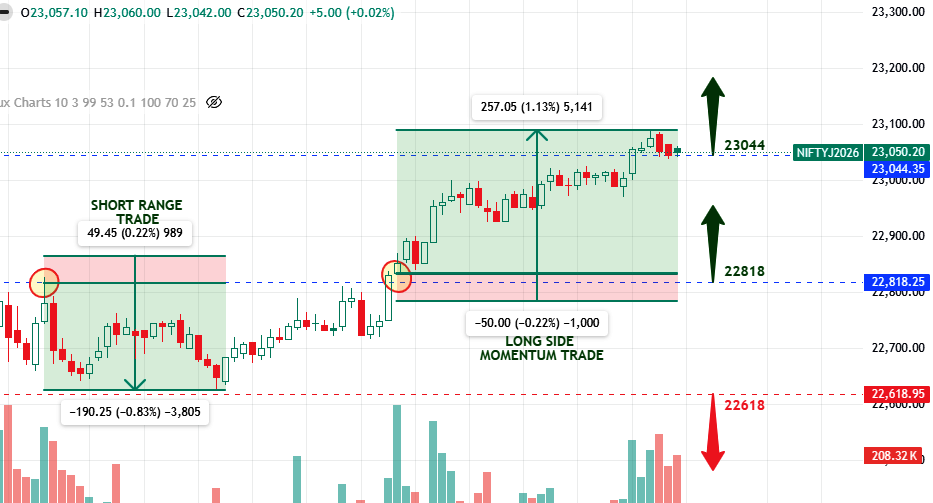
If one examines the five-minute chart of Nifty Futures during the early part of the session, it becomes evident that the market opened within the predefined vacuum range. Markets often display indecision when trading inside such zones because both buyers and sellers are trying to establish short-term dominance.
During the first hour of trading, Nifty Futures gradually moved toward the upper boundary of the range and eventually tested the level around 22,818. According to the rules of the setup, this level was already marked as a potential zone for initiating a short trade if the market approached it from below.
The short trade was triggered as the price reached that level, and the market soon began to move downward. The setup required a disciplined risk control mechanism with a stop loss of approximately fifty points. Once the trade moved in the anticipated direction, the decline gathered pace and the index eventually corrected by nearly 190 points from the level where the short trade was initiated.
Capturing around one hundred points from such a move was well within reach for traders who followed the setup faithfully.
One of the key principles of this strategy is that once the first trade of the day successfully reaches its intended objective, traders should ideally step away from the market rather than continuing to search for additional opportunities. This rule exists primarily to protect traders from emotional decision-making and unnecessary overtrading, which are two of the most common reasons for inconsistent trading performance.
A Secondary Learning Opportunity During the Session
Although the first trade itself fulfilled the objective of the strategy, the price action during the remainder of the day still offered a valuable learning opportunity from an educational standpoint.
For a considerable portion of the session, especially until around midday, Nifty Futures remained confined within a relatively narrow range. The price repeatedly approached the previously identified levels but initially failed to break them convincingly. The upper boundary remained around 22,818 while the lower boundary was located near 22,618.
These levels were not random numbers. They had been identified earlier as technically important zones where price reactions could occur. Markets often behave in this manner when participants are waiting for fresh triggers before committing to a directional move.
Eventually, during the second half of the trading session, the market succeeded in breaking above the upper boundary of 22,818 with stronger buying momentum. If a trader had not already participated in the earlier range trade and instead waited for confirmation of a breakout, this move could have offered another opportunity through a momentum-based strategy.
After crossing the resistance zone, the index demonstrated strong upward momentum and moved nearly 257 points higher while still allowing a controlled risk exposure through a stop loss of around fifty points.
Such situations clearly illustrate how markets often transition from range-bound behaviour to momentum-driven moves once important technical levels are breached.
Broader Market Performance on 6 April 2026
Despite the presence of negative signals from global markets for the second consecutive day, the domestic equity market displayed notable resilience.
The benchmark index, the Nifty 50, initially opened near the previous day’s closing levels. Shortly after the opening bell, the market witnessed some selling pressure, which briefly pushed prices lower.
However, the weakness did not last long. Buying interest gradually returned, and the market started recovering from its early losses. As the session progressed, this recovery gathered strength, allowing the index to move back toward the levels from which it had initially declined.
By the end of the day, Nifty managed to close with gains of roughly 1.12 percent. Market breadth also appeared supportive as a large number of stocks across the mid-cap and small-cap segments participated in the recovery. This broader participation helped restore some confidence among investors and contributed to the partial recovery seen in several portfolios.
Factors Influencing Market Sentiment
One of the possible reasons behind the improved sentiment appears to be emerging indications that tensions in West Asia might gradually move toward a de-escalation phase. While such developments remain fluid and subject to rapid change, even early signals of stability can influence market psychology.
At the same time, several global asset classes showed signs of strength. Precious metals such as gold and silver continued to trade positively, while digital assets also remained firm. Such simultaneous strength across different asset classes often indicates that global liquidity conditions are still supportive.
Nevertheless, caution remains necessary.
The India VIX, which measures expected market volatility, has declined slightly but continues to remain around the 25 level. Historically, this indicates that the market environment still carries a relatively elevated degree of uncertainty.
In the currency market, the Indian Rupee is trading close to the 93 per dollar zone. Meanwhile, global crude oil prices have softened somewhat and are currently trading near the 108-dollar level per barrel.
Even though these developments provide some relief, traders should continue to remain cautious until there is more clarity regarding geopolitical developments in West Asia.
Trading Framework for 7 April 2026
The trading structure that we follow for Nifty Futures is designed around a disciplined and probability-based approach. The primary objective of this framework is to maintain clarity of execution, protect trading capital, and prevent emotional decision-making.
A trader using this framework should ideally limit the number of trades taken during a session. In most circumstances, a maximum of two trades are considered sufficient. Typically, these may include one range-based trade and one momentum-based trade.
If the first trade itself achieves the expected target, it is often advisable to avoid taking any further positions during the same session. This principle helps maintain psychological discipline and ensures that traders do not give back their gains by over-participating in the market.
Range Trading Possibility for 7 April 2026
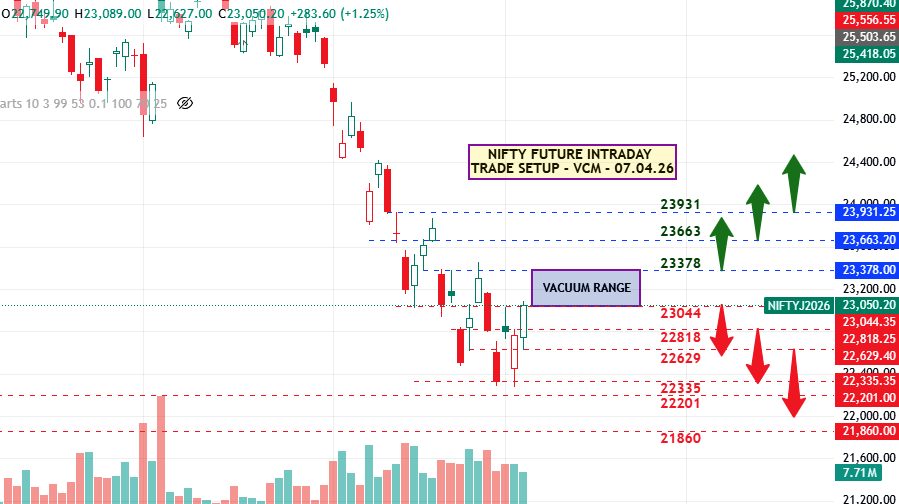
For the upcoming session, a vacuum range has been identified between 23,378 and 23,044 in Nifty Futures.
If the market opens within this range, traders may observe how price behaves near these boundaries before considering any action.
If the market approaches the upper boundary around 23,378 and shows signs of resistance, a short trade may be considered near that level. On the other hand, if the price declines toward the lower boundary near 23,044 and displays support, a long trade could be considered from that zone.
In both cases, maintaining disciplined risk control remains essential. A stop loss of approximately fifty points and a target of around one hundred points helps maintain a favourable risk-to-reward structure.
Momentum Trading Possibility
Momentum trades generally become relevant when the market breaks out of the defined range with convincing strength.
If Nifty Futures manages to sustain trading above 23,378, the breakout could attract fresh buying interest. Under such circumstances, a long momentum trade may emerge with potential resistance levels appearing near 23,663 and later around 23,931.
Conversely, if the index slips below 23,044 and begins trading decisively beneath that level, a short momentum scenario may develop. In that case, the next support zones may appear near 22,818 and subsequently around 22,629.
As always, disciplined stop-loss management remains an integral part of the trading framework.
Key Macro Developments in the Last 24 Hours
Several economic and geopolitical developments may continue to influence market sentiment in the coming days.
The three-day monetary policy meeting of the Reserve Bank of India has commenced on 6 April. Market participants are closely watching the outcome of this meeting, as policymakers assess inflation risks and global uncertainties before announcing their decision.
At the same time, the central bank has recently introduced measures in the foreign exchange market aimed at limiting excessive speculative activity. These steps are intended to improve stability in the currency market and protect the broader financial system.
Currency markets remain cautious, with the rupee trading near the 93 per dollar zone. Global energy markets also continue to attract attention as crude oil prices fluctuate in response to geopolitical developments.
Adding to the broader macro discussion, Jamie Dimon, the head of JPMorgan Chase, recently cautioned that prolonged geopolitical conflicts could create renewed inflation pressures globally, particularly if commodity prices remain elevated.
Final Thoughts
The trading session of 6 April 2026 once again highlighted the importance of discipline in financial markets. Structured strategies often perform well not because they predict the future with certainty, but because they create a consistent framework for decision-making.
For the upcoming session on 7 April 2026, traders should continue to observe price behaviour near the identified technical levels while maintaining strict risk control.
Markets may remain sensitive to both global developments and domestic policy decisions. Under such conditions, a balanced approach that combines technical analysis with prudent risk management can help traders navigate uncertainty more effectively.
Readers should remember that market analysis represents an interpretation of available data rather than a guarantee of future outcomes. Responsible participation in financial markets always requires independent judgement and careful consideration of individual risk tolerance.
MarkShala – Call to Action
Loved this analysis? Stay ahead in the markets with Markshala’s expert insights. Get deeper market research, trade setups, and investing guidance delivered straight to your inbox.
👉 For collaborations & queries: somnath@markshala.com
👉 WhatsApp Connect: +91 8209177236
Looking to invest in current NFOs or Bonds?
👉 Explore live investment opportunities here: Click Here
Click Here to join our partner Equity / Other Capital Market Investing Platform and unlock MarketShala’s expert-backed investing guidance. You may also join our WhatsApp community MarketShalians to stay tuned with regular updates in your wealth creation journey.
Click Here to join our partner in Crypto Currency Market Investing Platform and unlock MarketShala’s expert-backed investing guidance.
Stay informed. Stay profitable.
– Team Markshala
Disclaimer
The views and analysis provided above are for educational and informational purposes only and should not be considered as financial or investment advice. Trading and investing in the stock market involve risk, and past performance does not guarantee future results.
***********
|| ॐ नमः शिवाय ||