
The Indian equity market witnessed another highly volatile trading session on Thursday, 02 April 2026. The day began with a sharp gap-down opening in Nifty Futures, largely influenced by global geopolitical developments and overnight sentiment in international markets. Despite the initial pressure, the market displayed a notable recovery during the session and managed to close with relative stability.
In this article, we will review the intraday price behaviour of Nifty Futures, evaluate how the VCM trade setup performed during the session, and outline the trading framework for the next trading session scheduled on Monday, 06 April 2026. The discussion is based on technical price action analysis along with relevant macroeconomic developments that influenced market sentiment during the day.
Nifty Futures Intraday Performance – 02 April 2026
Before analysing the performance of the VCM trading setup, it is important to examine the intraday behaviour of Nifty Futures on the five-minute timeframe chart.
Once again, the market opened with a significant gap-down. Gap-up and gap-down openings are a common feature in equity markets, especially when global developments influence overnight sentiment. However, the magnitude of the opening gaps being observed in recent sessions has been unusually large. Such movements often indicate heightened uncertainty and strong reaction to external events rather than purely technical market behaviour.
When markets open with large gaps, the relevance of previously defined trading levels can be affected. In many cases, prices begin the session already positioned either in an oversold or overbought zone from an intraday perspective. Under such conditions, identifying a favourable risk-reward setup becomes considerably more challenging.
A similar situation was visible today.
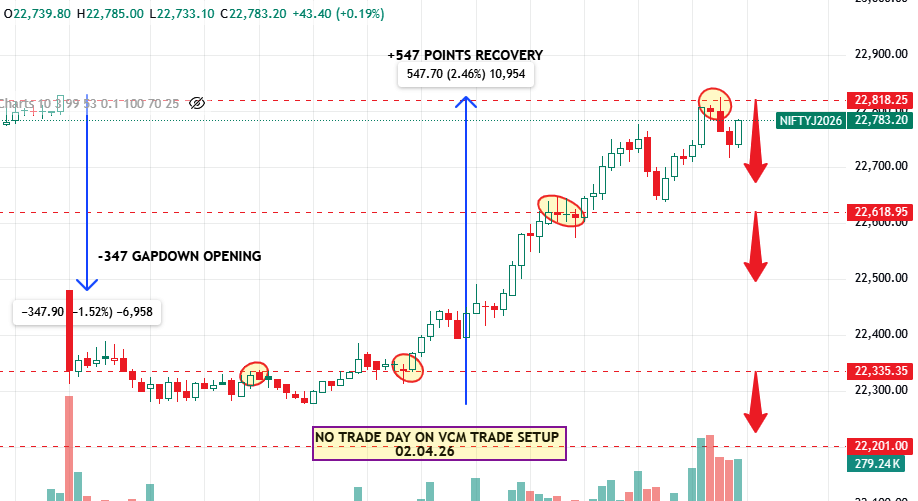
According to the VCM trading framework, the lower boundary of the vacuum range was placed at 22818, below which a short trade was expected to be considered. However, Nifty Futures opened with a gap-down of approximately 347 points. This opening level was already significantly below the first important support level placed at 22618.
From the opening level, the market continued to move in a largely one-directional manner and eventually reached the second support level near 22335.
After such a large gap-down and once the price had already reached the second support zone, initiating a fresh short trade would not have provided a favourable risk-reward structure. Entering a momentum trade at that stage could have exposed traders to higher risk relative to potential reward.
Therefore, according to the discipline of the VCM trading setup, the day was treated as a “No Trade Day.” Maintaining strict adherence to the rules of a trading framework is an essential part of professional trading practice. Ignoring predefined conditions simply to participate in market movement can often lead to inconsistent outcomes.
Interestingly, after reaching the support level near 22335, Nifty Futures witnessed a strong intraday recovery of roughly 547 points. While the recovery was significant in magnitude, it did not fall within the predefined rules of the VCM setup. For this reason, the movement is acknowledged as an observation rather than as a trade opportunity within the strategy.
Maintaining the integrity of a trading system requires consistency in execution, even when attractive moves appear outside the defined framework.
Market Behaviour on 02 April 2026
The market reaction during the day closely reflected the geopolitical and macroeconomic environment that unfolded overnight.
Early in the morning, global market sentiment weakened after comments related to the ongoing geopolitical tensions involving the United States and Iran gained attention. Statements suggesting the possibility of further escalation in the conflict created uncertainty across financial markets.
At the time of opening, the Nifty 50 index was showing a decline of more than two percent, reflecting the immediate impact of global risk aversion.
However, as the session progressed, the market gradually stabilised and eventually recovered a large part of the early losses. By the end of the trading session, the Nifty 50 index managed to close marginally higher by approximately 0.15 percent.
One of the macro factors that appeared to support this recovery was the strengthening of the Indian Rupee. The currency has been gaining ground for several consecutive sessions and is currently trading around the level of ₹93 against the US dollar. A strengthening currency often improves investor confidence, particularly for global institutional investors evaluating emerging markets.
Another observation worth noting is the market behaviour ahead of an extended weekend. In the past several weeks, markets have frequently closed with weakness before weekends as traders preferred to reduce exposure due to global uncertainties. In contrast, the market on this occasion showed resilience and closed near the day’s highs despite the upcoming long weekend.
Such behaviour may sometimes indicate that market participants are positioning themselves differently based on evolving expectations. However, rather than attempting to predict outcomes, it is generally more prudent to allow future price action to confirm the market’s direction.
Trading Framework for Nifty Futures – 06 April 2026
The trading approach for Nifty Futures continues to follow a structured and rule-based framework. The primary objective of this framework is to maintain discipline, protect trading capital, and focus on probability-based opportunities rather than impulsive decisions.
The strategy emphasises controlled trading activity and clear risk management parameters.
Under normal circumstances, a trader should ideally limit activity to a maximum of two trades during a session. These trades are generally structured as one range-based opportunity and one potential momentum opportunity. If the first trade itself achieves the defined target, it is often advisable to avoid further trades for the day. This approach helps prevent over-trading and supports psychological discipline.
Range-Based Trade Setup
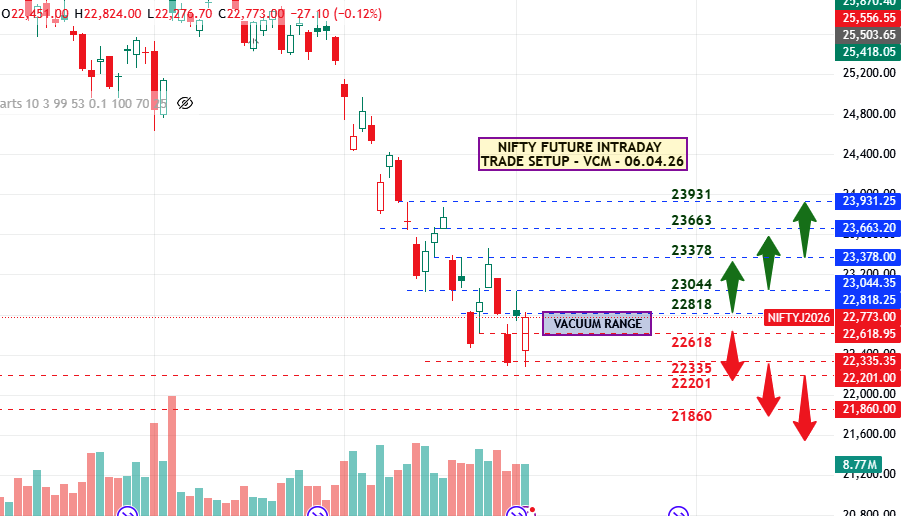
If Nifty Futures opens within the predefined vacuum range between 22818 and 22618, traders may observe which boundary of the range is approached first.
If the price moves toward the upper boundary near 22818 and shows signs of resistance, a short-side range trade may be considered near that level. Conversely, if the market approaches the lower boundary near 22618 first and displays support, a long-side range trade may be considered.
In both cases, the stop loss should remain limited to approximately fifty points, while the target for the range trade may be kept around one hundred points. This ensures a favourable risk-reward structure.
Momentum Trade Scenarios
If Nifty Futures moves decisively above the level of 22818, the market may enter a bullish momentum phase. Under such circumstances, a long-side momentum trade may be considered while maintaining the same disciplined risk management structure.
In this scenario, the next important resistance levels may appear near 23044 and subsequently around 23378.
Similarly, if Nifty Futures trades decisively below 22618, it may indicate bearish momentum. A short-side momentum trade may then be considered with appropriate risk management.
In the case of downward momentum, the next observable support levels may be located near 22335 and later around 22201.
Handling Gap-Up or Gap-Down Openings
If the market opens significantly outside the vacuum range due to a large gap-up or gap-down, the range-based trading setup becomes less relevant for that session.
In such situations, traders may prefer to focus only on momentum-based opportunities once the market establishes a clear directional move.
Key Global Developments During the Last 24 Hours
Global market sentiment has been influenced by several developments during the past day.
One of the most significant factors has been the escalation in geopolitical tensions between the United States and Iran. Statements indicating the possibility of further military action have increased uncertainty in international markets and have contributed to higher volatility.
Another notable development has been the sharp movement in crude oil prices. Brent crude has moved above the level of 100 dollars per barrel, reflecting concerns about potential disruptions in supply from the Middle East region. For energy-importing countries such as India, sustained increases in oil prices may create inflationary pressures.
At the same time, policymakers in India are reportedly reviewing certain trade-related measures to ensure adequate domestic supply of essential commodities in case global supply chains become disrupted. Such measures are typically considered as precautionary responses during periods of global uncertainty.
The cautious sentiment was also reflected in early indicators such as Gift Nifty, which showed significant declines during overnight trading due to rising energy prices and geopolitical risk.
Additionally, the global cryptocurrency market experienced some selling pressure as investors reduced exposure to high-risk assets during a period of increased macro uncertainty.
Concluding Perspective
Financial markets are currently navigating a complex environment shaped by geopolitical developments, currency movements, commodity price volatility and global economic expectations.
In such conditions, maintaining a disciplined trading approach becomes even more important. Price action remains the most reliable indicator of market sentiment, and structured strategies help traders respond to evolving conditions with clarity rather than emotion. By focusing on clearly defined trading levels, prudent risk management and patience in execution, market participants can navigate volatile phases while maintaining consistency in their decision-making process.
MarkShala – Call to Action
Loved this analysis? Stay ahead in the markets with Markshala’s expert insights. Get deeper market research, trade setups, and investing guidance delivered straight to your inbox.
👉 For collaborations & queries: somnath@markshala.com
👉 WhatsApp Connect: +91 8209177236
Looking to invest in current NFOs or Bonds?
👉 Explore live investment opportunities here: Click Here
Click Here to join our partner Equity / Other Capital Market Investing Platform and unlock MarketShala’s expert-backed investing guidance. You may also join our WhatsApp community MarketShalians to stay tuned with regular updates in your wealth creation journey.
Click Here to join our partner in Crypto Currency Market Investing Platform and unlock MarketShala’s expert-backed investing guidance.
Stay informed. Stay profitable.
– Team Markshala
Disclaimer
The views and analysis provided above are for educational and informational purposes only and should not be considered as financial or investment advice. Trading and investing in the stock market involve risk, and past performance does not guarantee future results.
***********
|| ॐ नमः शिवाय ||