
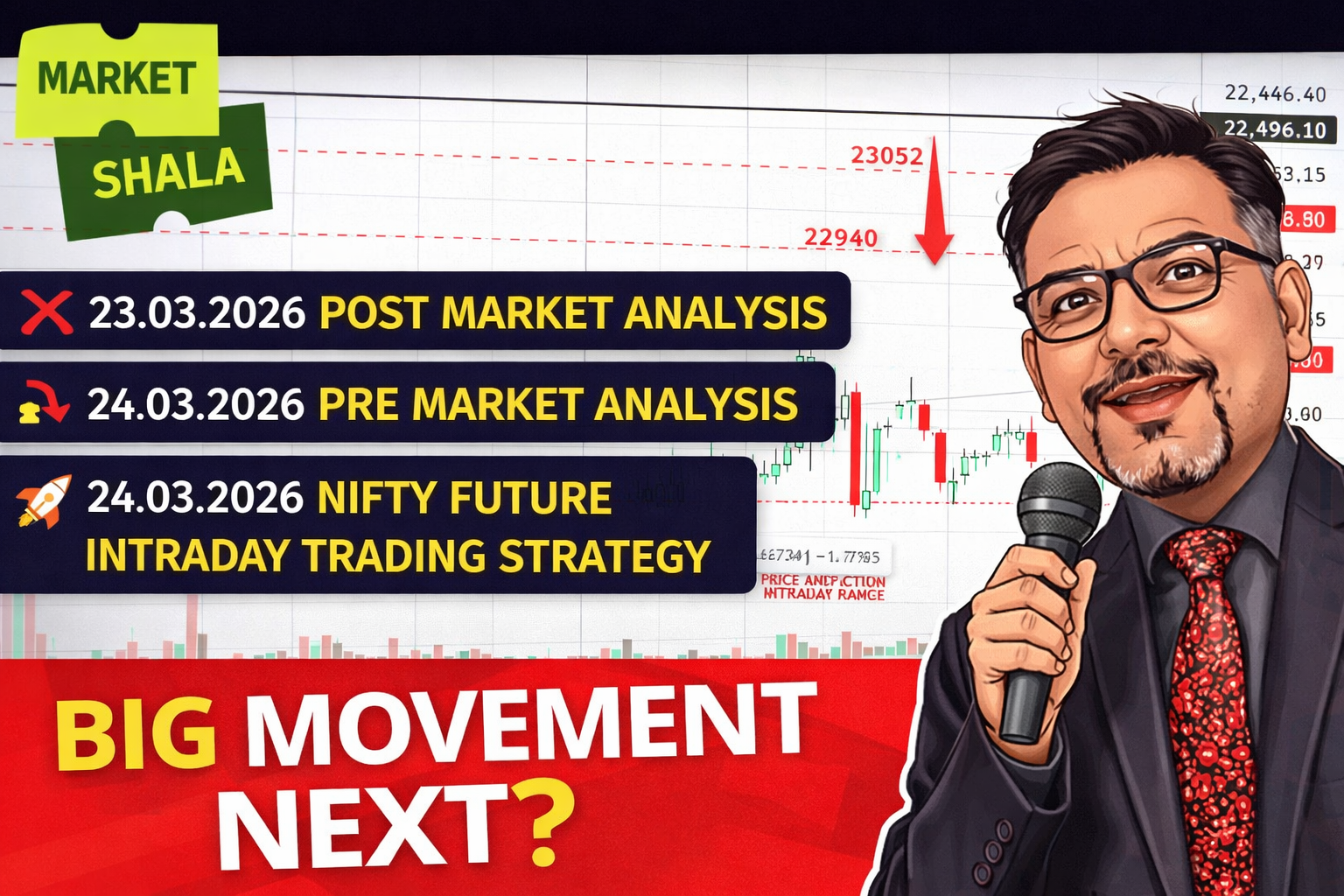
A Tough Trading Session for the Indian Markets
Monday, 23 March 2026, turned out to be one of those sessions where markets offered very little comfort to participants. The day was dominated by fear, uncertainty, and relentless selling pressure.
The Nifty 50 ended the session at 22,512, marking a decline of around 2.60 percent. This fall was not just a number on the screen—it reflected the broader nervousness gripping global as well as Indian markets. Reports suggest that nearly ₹15 lakh crore of investor wealth was eroded in a single trading session, highlighting the intensity of the sell-off.
What is more concerning is that the index has now corrected significantly from its recent highs, and investors are beginning to feel the emotional strain of continuous drawdowns in their portfolios.
Intraday Perspective: Why Discipline Meant Staying Away
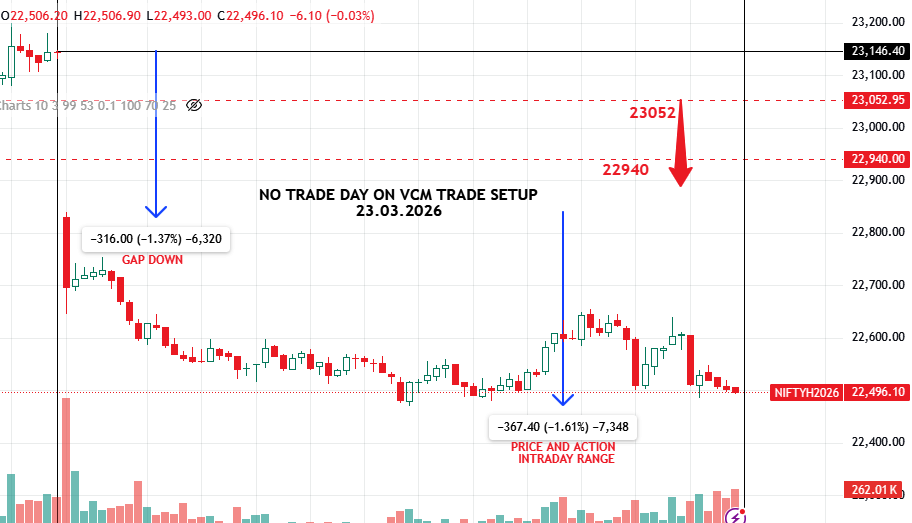
From a trader’s perspective, the day began with a sharp gap-down opening in Nifty Futures, which immediately set the tone for the session. The index opened lower by 316 points and continued to decline further by approximately 367 points during the day.
At first glance, such large intraday movements might appear attractive for trading opportunities. However, professional trading is not about chasing volatility—it is about executing a well-defined setup with discipline.
As per the VCM (Vacuum Concept Model) approach that we regularly discuss, today’s structure did not offer a valid entry. The reason was straightforward. The market opened outside the defined vacuum range, which automatically invalidated range-based trades. Throughout the session, the price action remained one-directional, without offering any meaningful pullback or reversal near predefined levels.
This kind of price behaviour is often described as a “falling knife,” where the market keeps declining without providing safe entry points. Attempting to trade in such conditions without confirmation can be risky and may lead to unnecessary losses.
Days like these are not about how much you trade, but about how well you control your urge to trade. For traders, especially those who are still learning, this was a true test of patience and discipline.
Broader Market Context: Fear Driven by Global Uncertainty
The ongoing geopolitical tensions in West Asia continue to influence market sentiment in a significant way. The evolving situation involving global powers, along with uncertainty around leadership decisions linked to figures like Donald Trump, has made the environment increasingly unpredictable.
Markets do not like uncertainty, and when it is combined with the risk of supply disruptions—especially in energy—the reaction tends to be sharp and immediate.
From a technical standpoint, the next important support zone for Nifty is seen around 21,769. Whether the market stabilizes before reaching that level or continues to drift lower is difficult to predict at this stage. In situations driven by geopolitical developments, traditional forecasting often becomes less reliable.
A Note for Investors: Staying Grounded in Volatile Times
For investors, the current phase can be emotionally challenging. Watching portfolios decline day after day can lead to impulsive decisions.
However, it is important to recognize that markets are approaching oversold territory. Historically, selling in panic during such phases has often proven to be a suboptimal decision for long-term participants.
Maintaining patience, focusing on asset allocation, and avoiding emotional reactions remain critical during such times.
Nifty Futures Trading Plan for Tuesday, 24 March 2026
A Structured Approach to Trading
The trading framework remains rooted in discipline and clarity. The objective is not to trade frequently, but to trade effectively.
Ideally, a trader should limit the number of trades to a maximum of two in a session. If the first trade achieves its intended outcome, it is often wiser to step aside rather than continue trading. This approach helps in preserving both capital and mental clarity.
Understanding the Trade Setup
If the market opens within the defined vacuum range, the focus should be on observing how price behaves near key levels rather than predicting direction.
If the upper boundary is approached first, it may offer a short-side opportunity. On the other hand, if the lower boundary is tested initially, a long-side trade may be considered. The idea is to react to price behaviour rather than anticipate it.
Once a trade is initiated, two possibilities can emerge. In one case, the trade moves in favour and achieves the target, allowing the trader to exit and conclude the day. In the other case, the market may reverse strongly, indicating a potential breakout. In such a situation, the strategy can shift from range trading to momentum-based participation.
Handling Gap Openings
If the market opens significantly higher or lower, outside the defined range, the range-based setup becomes irrelevant for the session. In such cases, the focus should shift entirely to momentum trades, ensuring that entries are aligned with clear price confirmation.
Risk Management: The Core Principle
Every trade should be executed with predefined risk parameters.
The stop-loss should remain limited to 50 points, while the minimum target should be 100 points. This ensures a favourable risk-to-reward structure, which is essential for long-term sustainability in trading.
Key Levels for 24 March 2026
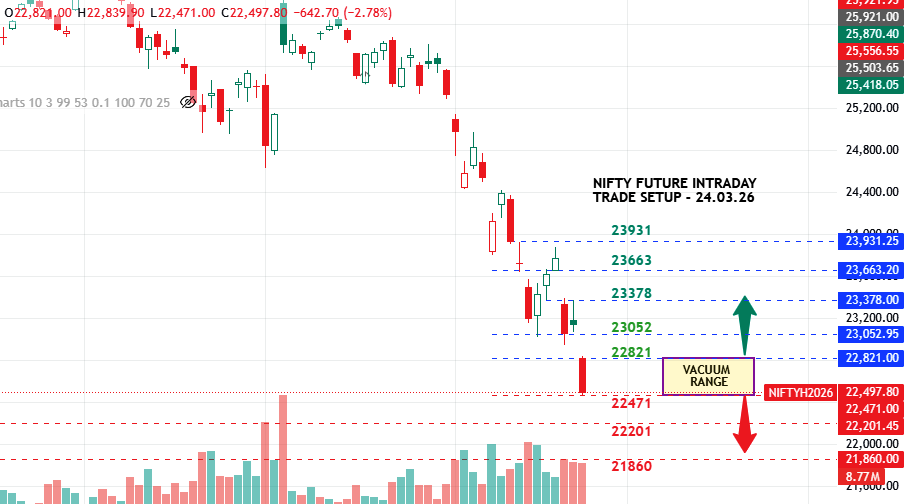
For the upcoming session, the vacuum range for Nifty Futures is placed between 22,821 and 22,471.
If the market opens within this zone and approaches the upper boundary first, a short trade may be considered near 22,821. Conversely, if the lower boundary is tested first, a long trade may be considered near 22,471. In both cases, maintaining the defined stop-loss and target structure is important.
If the market moves decisively above 22,821, it may indicate bullish momentum. In such a scenario, a long trade can be explored, with resistance levels seen near 23,052 and 23,378.
On the downside, if the price sustains below 22,471, it may open the door for further weakness. A short trade can be considered in this case, with support levels around 22,201 and 21,860.
Key Global Developments in the Last 24 Hours
Recent global developments have played a major role in shaping market sentiment.
The International Energy Agency has highlighted that the ongoing conflict involving major global powers poses a serious risk to the global economy. Supply disruptions in crude oil have already reached significant levels, raising concerns about inflation and growth.
Markets across Asia and Europe have reacted negatively, reflecting risk aversion among investors. Tensions around critical trade routes such as the Strait of Hormuz have added to the uncertainty.
In India, Narendra Modi has reassured that the country has sufficient reserves of essential resources like fuel and coal, and is well-prepared to handle external shocks. However, the government has also acknowledged that prolonged conflict could impact supply chains and inflation.
Interestingly, despite rising uncertainty, precious metals like gold and silver have not behaved as traditional safe-haven assets in the short term, indicating that liquidity dynamics and interest rate expectations are also influencing market behaviour.
Final Thoughts
Markets at this stage are being driven more by external uncertainties than internal strength. This makes price action sharper and less predictable.
For investors, the focus should remain on patience and long-term perspective. For traders, the emphasis should be on discipline, risk management, and strict adherence to a well-defined system.
In challenging times like these, the real edge lies not in predicting the market, but in managing oneself.
MarkShala – Call to Action
Loved this analysis? Stay ahead in the markets with Markshala’s expert insights. Get deeper market research, trade setups, and investing guidance delivered straight to your inbox.
👉 For collaborations & queries: somnath@markshala.com
👉 WhatsApp Connect: +91 8209177236
Looking to invest in current NFOs or Bonds?
👉 Explore live investment opportunities here: Click Here
Click Here to join our partner Equity / Other Capital Market Investing Platform and unlock MarketShala’s expert-backed investing guidance. You may also join our WhatsApp community MarketShalians to stay tuned with regular updates in your wealth creation journey.
Click Here to join our partner in Crypto Currency Market Investing Platform and unlock MarketShala’s expert-backed investing guidance.
Stay informed. Stay profitable.
– Team Markshala
Disclaimer
The views and analysis provided above are for educational and informational purposes only and should not be considered as financial or investment advice. Trading and investing in the stock market involve risk, and past performance does not guarantee future results.
***********
|| ॐ नमः शिवाय ||