
The Indian equity market experienced a deeply negative session on Thursday, 19 March 2026, as rising geopolitical tensions in West Asia triggered a wave of panic across global financial markets. What initially appeared to be a weak opening gradually turned into a broad-based sell-off, reflecting how sensitive the current market environment is to global developments.
This session was not just another correction. It marked a shift in short-term sentiment, where external macro factors overpowered domestic cues and technical stability.
Let us understand the day in detail, followed by a structured outlook for the next trading session.
Intraday Trade Review: Patience Rewarded Once Again
As discussed in the previous session’s plan, the trading approach was clearly defined with a focus on discipline and level-based execution.
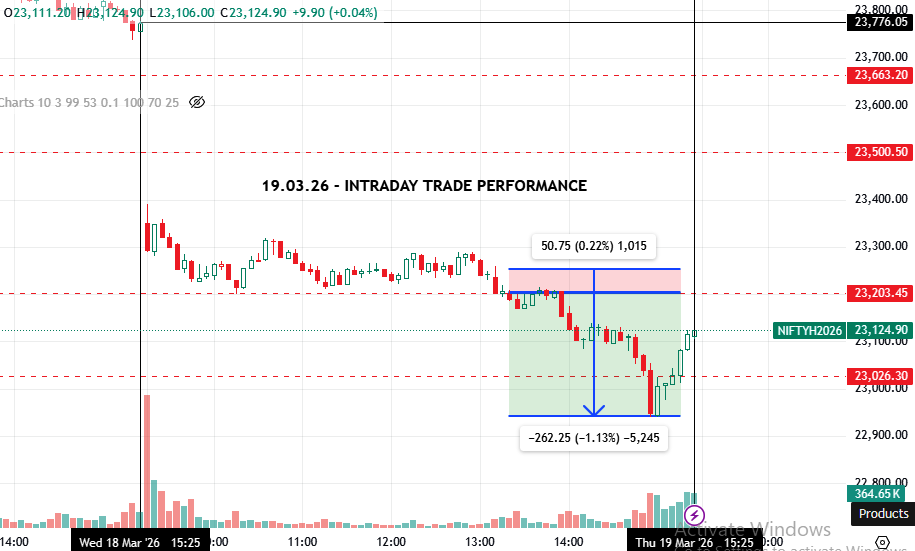
The market opened with a significant gap-down, which immediately placed Nifty Futures outside the predefined vacuum range. As per the framework, this automatically nullified any range-based trading opportunities for the day. Such situations often test a trader’s patience, as the temptation to take early trades increases when volatility is high.
However, the real opportunity unfolded later in the session.
In the second half, when Nifty Futures approached and decisively broke the 23203 level, it signaled the continuation of weakness that had already been building. What followed was a sharp downward move, with the index falling approximately 262 points from that breakdown zone. Importantly, the predefined stop-loss of 50 points remained intact throughout, reinforcing the effectiveness of a controlled risk approach.
This was a classic example of how waiting for confirmation rather than anticipating moves can lead to high-probability trades. Traders who exercised patience and respected levels were able to benefit from the momentum, while avoiding unnecessary risk during the uncertain opening phase.
Market Behaviour on 19 March 2026: A Day Dominated by Fear
The broader market displayed clear signs of stress throughout the day.
The Nifty Spot Index declined by 3.26 percent, which is a substantial move for a single session. What makes this fall more significant is that it erased the gains of the previous three sessions right from the opening itself. As the day progressed, selling pressure intensified across sectors, indicating a lack of confidence among participants.
From its recent highs, the index has now corrected by nearly 13 percent, suggesting that the market has entered a phase where caution is warranted in the short term.
The primary driver behind this fall was not domestic weakness but external geopolitical developments. This is important to understand because markets driven by global uncertainty tend to remain volatile and less predictable.
Global Developments Influencing the Market
Over the last 24 hours, global events have played a crucial role in shaping market sentiment.
The ongoing conflict in West Asia has intensified further, involving major global powers and impacting key energy infrastructure. This has led to a sharp rise in crude oil prices, crossing the 110 to 115 dollar range. Such a spike in energy prices directly impacts inflation expectations worldwide.
At the same time, disruptions in the Strait of Hormuz have started affecting India’s LPG supply chain. Given India’s dependence on imports for a significant portion of its energy needs, such disruptions can have a direct impact on inflation and consumption patterns within the economy.
Global equity markets have also reacted negatively. European and Asian markets have seen notable declines, while investors have shifted towards relatively safer assets such as the US dollar and government bonds. This shift clearly indicates a risk-off sentiment.
Another important development is the change in expectations around global monetary policy. Central banks, which were earlier expected to move towards rate cuts, may now adopt a more cautious stance due to rising inflation risks. This is generally not supportive for equity markets.
Interestingly, this entire situation is unfolding at a time when global economic data has been relatively strong. This creates a complex environment where strong growth indicators are being overshadowed by geopolitical risks, making the future direction uncertain.
Trading Strategy for Nifty Futures: 20 March 2026
In such volatile conditions, it becomes even more important to follow a structured and rule-based approach rather than reacting emotionally to market movements.
The core philosophy remains unchanged. The idea is to limit the number of trades, focus on quality setups, and maintain strict risk control. Ideally, no more than two trades should be taken in a session. If the first trade achieves the intended outcome, it is often better to step aside rather than overtrade.
For the upcoming session, the key levels are clearly defined.
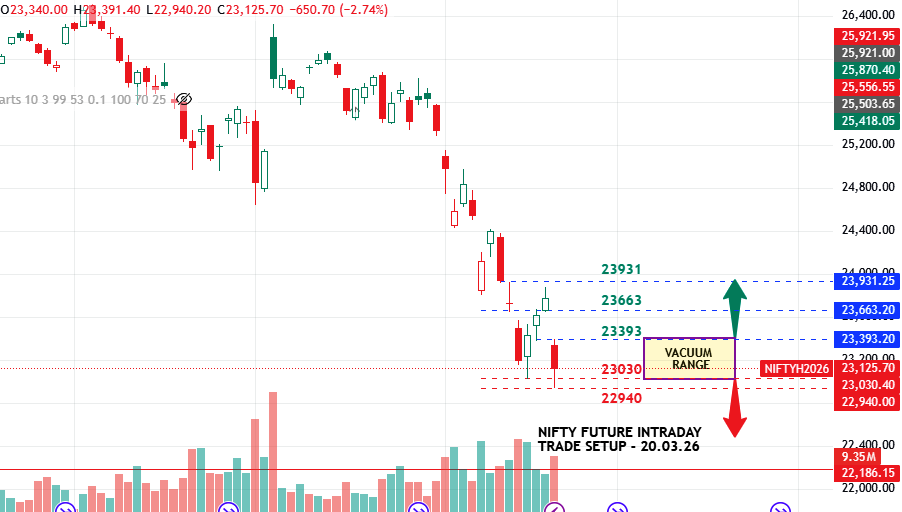
If Nifty Futures opens within the range of 23393 to 23030, the approach will be to observe which side of the range is tested first. A move towards the upper boundary may provide an opportunity to consider a short trade, while a move towards the lower boundary may open up a possibility on the long side. In both cases, the stop-loss should remain limited to 50 points, with a minimum target of 100 points, maintaining a favourable risk-reward structure.
If the market shows strength and sustains above 23393, it may indicate a shift towards upward momentum. In such a scenario, a long trade can be considered with defined risk parameters. The immediate resistance levels to watch would be around 23663 and then near 23931.
On the other hand, if weakness continues and the price moves decisively below 23030, it would suggest continuation of the downtrend. In that case, a short trade may be considered, with downside levels around 22940 and further near 22186.
In case of a gap-up or gap-down opening outside this defined range, the range-based strategy should be avoided altogether. The focus should then shift only to momentum-based opportunities, as was seen in today’s session.
Risk Management and Discipline: The Real Edge
It is important to highlight that no strategy can work without proper risk management. The consistent application of a 50-point stop-loss and a minimum 100-point target ensures that the overall approach remains sustainable over time.
Equally important is the ability to stay patient and avoid unnecessary trades. In volatile markets, the difference between success and failure often lies not in predicting the market, but in controlling one’s actions.
Final Thoughts
The events of 19 March 2026 clearly demonstrate how quickly market sentiment can change when global risks escalate. While technical levels continue to provide structure, external factors are currently playing a dominant role.
Going forward, traders should remain cautious, avoid aggressive positioning, and focus on disciplined execution. Opportunities will continue to arise, but only for those who are willing to wait for the right setups and manage risk effectively.
MarkShala – Call to Action
Loved this analysis? Stay ahead in the markets with Markshala’s expert insights. Get deeper market research, trade setups, and investing guidance delivered straight to your inbox.
👉 For collaborations & queries: somnath@markshala.com
👉 WhatsApp Connect: +91 8209177236
Looking to invest in current NFOs or Bonds?
👉 Explore live investment opportunities here: Click Here
Click Here to join our partner Equity / Other Capital Market Investing Platform and unlock MarketShala’s expert-backed investing guidance. You may also join our WhatsApp community MarketShalians to stay tuned with regular updates in your wealth creation journey.
Click Here to join our partner in Crypto Currency Market Investing Platform and unlock MarketShala’s expert-backed investing guidance.
Stay informed. Stay profitable.
– Team Markshala
Disclaimer
The views and analysis provided above are for educational and informational purposes only and should not be considered as financial or investment advice. Trading and investing in the stock market involve risk, and past performance does not guarantee future results.
***********
|| ॐ नमः शिवाय ||