

The Indian stock market extended its upward move for the third consecutive session on Wednesday, 18 March 2026. While the headline indices reflected strength, a deeper look into price structure, broader sentiment, and global developments suggests that traders should remain balanced rather than aggressively bullish. In this article, we will break down today’s intraday performance in Nifty Futures, evaluate the overall market condition, and prepare a structured trading approach for the next session, 19 March 2026.
Intraday Performance of Nifty Futures – What Worked Today
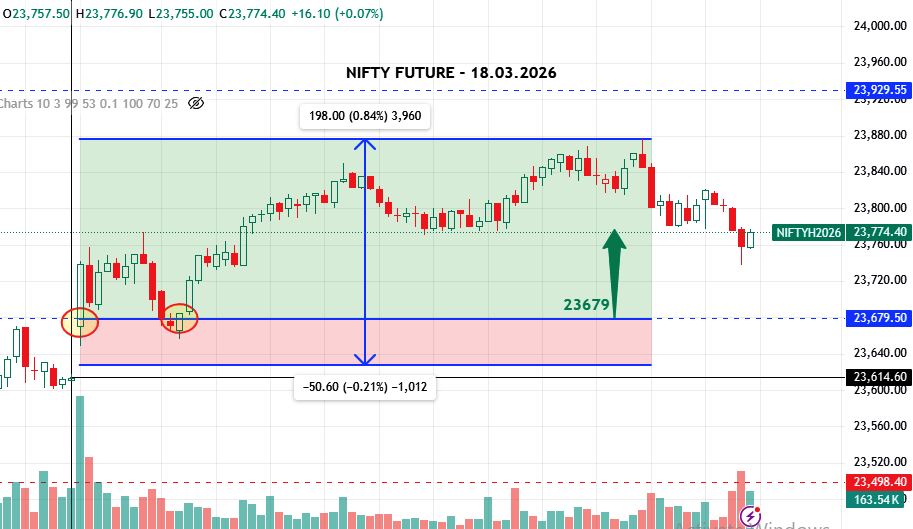
If we revisit the levels discussed in the previous session, today’s opening itself provided a clear directional bias. The market opened with a gap-up, and importantly, this opening was outside the predefined vacuum range. According to the trading framework we follow, such an opening immediately cancels the possibility of a range-bound trade for the day and shifts the focus entirely toward momentum-based opportunities.
The upper boundary of the earlier identified range was placed around 23679. This level once again proved its importance. During the session, the market offered more than one opportunity to initiate a long trade near this zone, strictly based on price behaviour.
With a disciplined stop loss of 50 points, the price moved sharply in favour of the trade, delivering a move of nearly 200 points in Nifty Futures. This reinforces a simple but often overlooked reality of trading — price and action remain the most reliable indicators.
There were no oscillators, no complex indicators, and no predictive assumptions involved. The entire trade was built on observation, patience, and execution. Over time, this approach not only improves consistency but also helps in maintaining emotional stability during volatile sessions.
Market Overview – Strength on the Surface, Caution Beneath
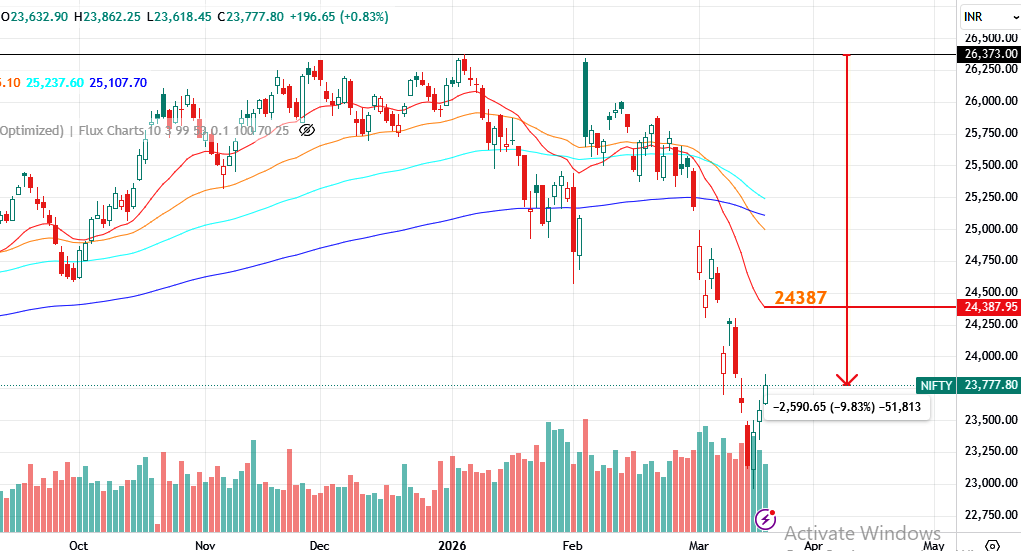
On the closing basis, Nifty ended the day at 23,777, registering a gain of approximately 0.83 percent. At first glance, three consecutive days of upward movement may appear to signal a strong bullish trend. However, it is important to interpret this move in the right context.
From a structural perspective, the broader sentiment has not yet turned convincingly positive. A key technical parameter that still remains unmet is the position of Nifty relative to its 20-day exponential moving average, which is currently placed much higher around the 24,387 zone. Until the index is able to reclaim and sustain above this level, it would be premature to conclude that the market has entered a strong bullish phase.
That said, one encouraging sign from today’s session was the improvement in market breadth. A significantly higher number of stocks participated in the upward move compared to those that declined. This indicates that the rally was not restricted to a handful of large-cap stocks, but had broader participation. For investors who have experienced drawdowns in recent sessions, this kind of breadth often brings some relief, at least in the short term.
Currency Movement and Late Session Behaviour
An interesting development during the day was the weakness observed in the Indian Rupee during the final hour of trading. This weakness led to some selling pressure from the day’s higher levels. While the fall was not dramatic, it serves as a reminder that macroeconomic factors continue to influence intraday movements.
Currency fluctuations, especially in a globally sensitive environment, can quickly alter market sentiment. Traders should remain mindful of such developments, particularly when markets are approaching resistance zones.
Global Context – Why External Factors Still Matter
The global backdrop remains uncertain, with ongoing tensions involving the United States, Israel, and Iran continuing to influence energy markets and investor sentiment.
Oil price volatility, supply chain concerns, and shifting geopolitical alignments are creating an environment where markets can react sharply to any new development. At the same time, there is a noticeable shift in how global powers are approaching these tensions. Instead of immediate alignment, countries are increasingly acting in their own strategic interests.
In this context, India appears to be following a balanced and pragmatic approach. Whether it is maintaining energy supplies through diplomatic engagement or managing trade relationships, the focus seems to be on stability rather than reaction. For market participants, these developments are not just headlines. They directly impact inflation expectations, currency behaviour, and sectoral performance, especially in energy and commodities.
Trading Framework for 19 March 2026 – A Structured Approach
As we prepare for the next trading session, it is important to approach the market with a clear and disciplined plan rather than predictions.
The framework remains simple. The objective is not to trade frequently, but to trade correctly. Ideally, no more than two trades should be considered in a day. If the first trade achieves its intended outcome, it is often wiser to step aside rather than force additional trades.
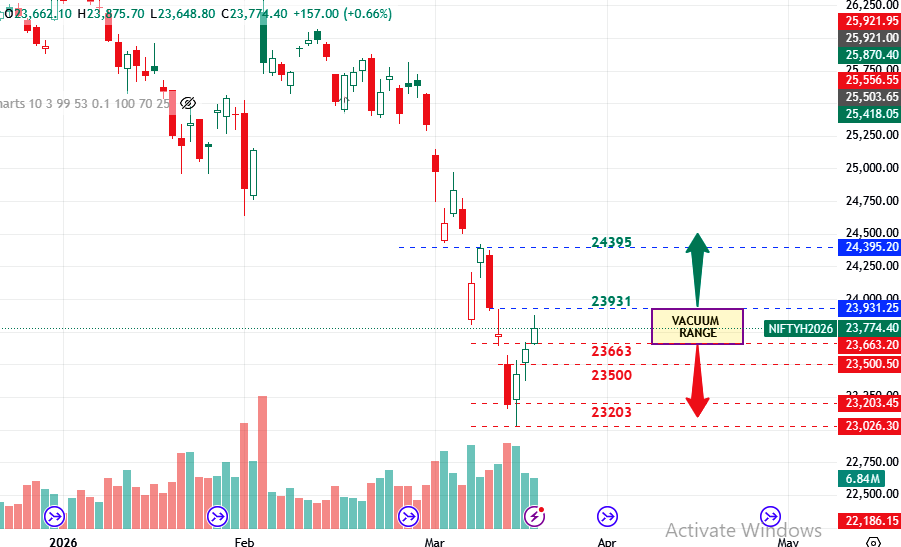
For 19 March 2026, the important levels for Nifty Futures are as follows:
The upper boundary is placed near 23,931, while the lower boundary is around 23,663. These levels define the operating zone for the session.
If the market opens within this range, the focus should be on observing which side gets tested first. A move toward the upper boundary may offer an opportunity on the short side, while a move toward the lower boundary may provide a long opportunity. The emphasis should remain on confirmation through price behaviour rather than anticipation.
In case the market does not respect the range and instead shows a decisive move beyond either boundary, the approach should shift toward momentum trading. A sustained move above 23,931 may indicate strength, where long positions can be considered with controlled risk. Similarly, a break below 23,663 may indicate weakness, allowing for short-side participation.
In both scenarios, maintaining a disciplined stop loss of 50 points and a minimum target of 100 points helps in preserving a favourable risk-to-reward structure. This balance is essential for long-term consistency in trading.
Key Developments from the Last 24 Hours
The broader market environment continues to be shaped by a combination of geopolitical and economic developments.
Tensions in the Middle East have intensified further, leading to disruptions in energy markets and a sharp rise in gas prices across parts of Europe. This has once again brought the focus back on energy security and alternative sources.
India, on the other hand, is actively managing supply-side challenges by increasing domestic LPG production and ensuring that disruptions do not significantly impact availability. This reflects a degree of resilience in handling external shocks.
In the United States, expectations are building around a pause in interest rate changes despite rising oil prices and softer employment data. This has helped maintain a certain level of stability in global equity markets.
At the same time, disruptions around critical oil transit routes have pushed crude prices significantly higher in recent weeks. This remains a concern for import-dependent economies.
There is also a growing view that India may play a more active diplomatic role in stabilizing the West Asian region, which could have long-term implications for both economic and strategic interests.
Final Perspective
The current market phase is best described as a combination of short-term strength and medium-term caution. While price action is offering trading opportunities, the underlying structure has not yet fully confirmed a strong bullish trend.
In such an environment, the focus should remain on discipline, risk management, and clarity of execution.
The market does not reward opinions. It rewards patience and consistency.
MarkShala – Call to Action
Loved this analysis? Stay ahead in the markets with Markshala’s expert insights. Get deeper market research, trade setups, and investing guidance delivered straight to your inbox.
👉 For collaborations & queries: somnath@markshala.com
👉 WhatsApp Connect: +91 8209177236
Looking to invest in current NFOs or Bonds?
👉 Explore live investment opportunities here: Click Here
Click Here to join our partner Equity / Other Capital Market Investing Platform and unlock MarketShala’s expert-backed investing guidance. You may also join our WhatsApp community MarketShalians to stay tuned with regular updates in your wealth creation journey.
Click Here to join our partner in Crypto Currency Market Investing Platform and unlock MarketShala’s expert-backed investing guidance.
Stay informed. Stay profitable.
– Team Markshala
Disclaimer
The views and analysis provided above are for educational and informational purposes only and should not be considered as financial or investment advice. Trading and investing in the stock market involve risk, and past performance does not guarantee future results.
***********
|| ॐ नमः शिवाय ||