

The market continues to operate in a phase where uncertainty and opportunity exist side by side. While global developments are adding layers of volatility, price action within the domestic market is still offering structured trading opportunities for those who follow discipline.
In this article, we take a detailed look at how Nifty Futures behaved during today’s session, what it tells us about the current market structure, and how traders can approach the next trading session with clarity and control.
Intraday Price Action Review – 17 March 2026
Today’s session once again demonstrated how effective a simple, rule-based trading framework can be when combined with patience and execution discipline.
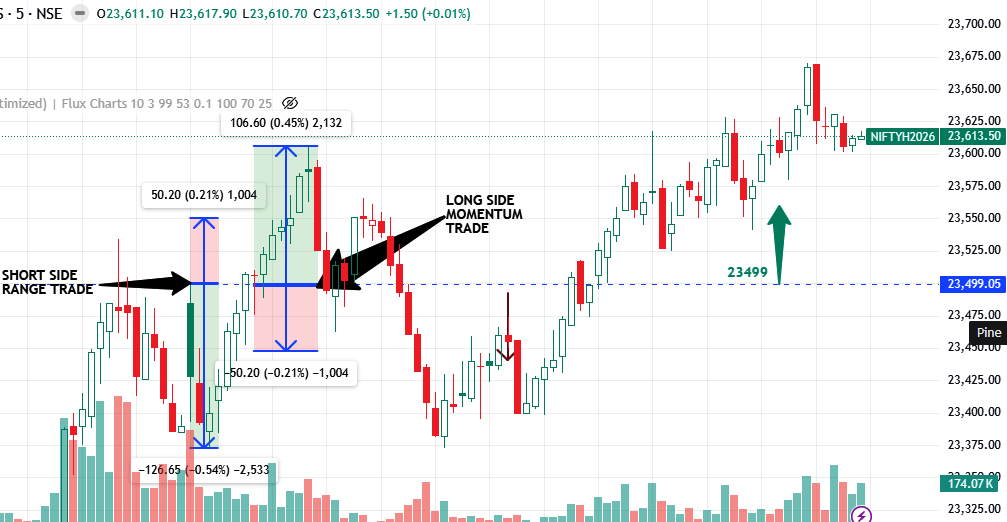
At the start of the session, Nifty Futures opened within the predefined vacuum range. Instead of reacting impulsively, the focus remained on observing which side of the range would be tested first. Within the initial minutes, price moved towards the upper boundary around 23499. As per the discussed framework, this created an opportunity to initiate a short position near the resistance zone.
What followed was a clean reaction from the market. Selling pressure emerged from that level and the index moved lower by approximately 126 points. This was a classic example of how markets tend to respond at predefined zones when participants are aligned with levels.
Later in the session, the structure evolved. Nifty Futures did not remain confined to the range and eventually managed to break above the same upper boundary with strength. This shift from range behaviour to directional movement provided a second opportunity, this time on the long side. The breakout was supported by momentum and resulted in an upward move of around 106 points.
From a learning perspective, the session reinforces a simple idea. Trading does not always require complex indicators or excessive data inputs. A structured approach based on price levels, predefined rules and controlled risk can often simplify decision-making and improve consistency.
Market Overview – 17 March 2026
On the broader market front, Nifty Spot closed at 23,581, registering a gain of around 0.74 percent. This marks the second consecutive positive close, which may appear encouraging at first glance. However, a deeper analysis suggests that the overall sentiment has not yet undergone a decisive shift.
Market breadth showed some improvement, with advancing stocks outnumbering declining ones. While this indicates some participation from the broader market, it is still not strong enough to confirm a sustained bullish phase.
At the current juncture, it would be premature to conclude that the market trend has reversed. In fact, from a structural perspective, a meaningful improvement in sentiment may require a much stronger upward move from current levels. Until that happens, intermittent rallies can still face selling pressure.
Another important aspect to consider is the oversold nature of the market. After a phase of correction, it is natural to see buying interest emerging at lower levels. The key question, however, is whether this buying will sustain or fade after short-term recoveries. The answer to that will unfold over the next few sessions.
For now, the most practical approach is to remain aligned with price behaviour rather than assumptions. Emotional decision-making can be particularly harmful in such phases, where the market can shift direction quickly.
Approach for Investors
For long-term participants, the current phase should not be viewed with anxiety but with perspective. Volatility is an inherent part of equity markets, and periods of uncertainty often create opportunities for disciplined investors.
Continuing systematic investment plans without interruption remains a sensible approach. Those looking to deploy capital may consider gradual accumulation in fundamentally strong businesses or through diversified mutual fund exposure. Timing the exact bottom is often difficult, but consistency over time tends to yield better outcomes.
Trading Framework for 18 March 2026
The trading approach for the next session continues to be rooted in discipline, risk control and clarity of execution. The objective is not to predict the market but to respond to it based on predefined conditions.
A key principle of this framework is limiting the number of trades. Ideally, no more than two trades should be taken during the session. If the first trade itself achieves the intended outcome, it is often better to step aside rather than overtrade.
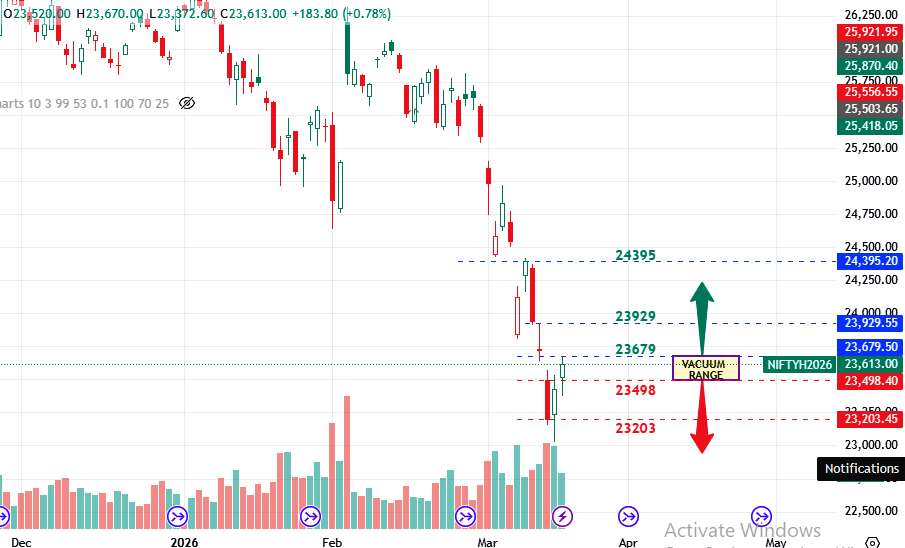
For the upcoming session, the vacuum range is identified between 23,679 on the higher side and 23,498 on the lower side.
If the market opens within this range, patience becomes important. Instead of entering immediately, the focus should be on observing which boundary is tested first. A move towards the upper level may provide a short-side opportunity, while a move towards the lower level may create a long-side setup. The idea is to react to price behaviour rather than anticipate it.
Once a trade is initiated within the range, two possibilities can emerge. In one scenario, the trade works in favour and achieves the intended target, in which case it is advisable to close the position and avoid further trades. In the other scenario, the market may reverse sharply and break out of the range, signalling a shift towards momentum-driven movement.
If Nifty Futures moves decisively above 23,679, it may indicate strength and create a potential long-side opportunity. On the other hand, a decisive move below 23,498 may indicate weakness and open up the possibility of a short-side trade. In both cases, the focus should remain on maintaining a favourable risk-to-reward structure.
Risk management is central to this framework. Keeping stop-loss levels defined and ensuring that potential reward justifies the risk taken is essential for long-term sustainability.
It is also important to adapt in case of a gap-up or gap-down opening. If the market opens outside the predefined range, the range-based approach becomes less relevant for that session. In such cases, it is more appropriate to wait for clarity and consider only momentum-based opportunities, rather than forcing trades.
Global and Economic Developments to Watch
Over the last 24 hours, global developments have once again highlighted how interconnected financial markets have become.
Tensions in the Middle East have escalated further, involving Israel and Iran, with activity reported across regions such as Tehran and Beirut. Such developments tend to create uncertainty in global markets, particularly around energy supply routes.
This has already reflected in crude oil prices, with Brent Crude Oil moving above the $100 mark. For an economy like India, rising oil prices can have multiple implications, including pressure on inflation and the currency.
At the domestic level, concerns around LPG supply disruptions have started to emerge, which could have a direct impact on household expenses as well as certain consumption-driven sectors.
In Europe, Germany has reported a sharp decline in investor sentiment, indicating that global growth concerns are not entirely behind us. Such signals often influence broader risk appetite across markets.
At the same time, long-term structural developments continue to take shape. Adani Group has outlined a significant investment plan aimed at strengthening infrastructure and energy resilience. While such developments may not have an immediate market impact, they play an important role in shaping long-term economic direction.
Final Thoughts
The market is currently navigating a phase where clarity is limited but opportunities still exist for those who remain disciplined.
For traders, the focus should remain on following price action, maintaining risk control and avoiding unnecessary trades. For investors, the emphasis should be on consistency and patience rather than short-term fluctuations.
As always, markets do not reward prediction; they reward preparation and disciplined execution.
MarkShala – Call to Action
Loved this analysis? Stay ahead in the markets with Markshala’s expert insights. Get deeper market research, trade setups, and investing guidance delivered straight to your inbox.
👉 For collaborations & queries: somnath@markshala.com
👉 WhatsApp Connect: +91 8209177236
Looking to invest in current NFOs or Bonds?
👉 Explore live investment opportunities here: Click Here
Click Here to join our partner Equity / Other Capital Market Investing Platform and unlock MarketShala’s expert-backed investing guidance. You may also join our WhatsApp community MarketShalians to stay tuned with regular updates in your wealth creation journey.
Click Here to join our partner in Crypto Currency Market Investing Platform and unlock MarketShala’s expert-backed investing guidance.
Stay informed. Stay profitable.
– Team Markshala
Disclaimer
The views and analysis provided above are for educational and informational purposes only and should not be considered as financial or investment advice. Trading and investing in the stock market involve risk, and past performance does not guarantee future results.
***********
|| ॐ नमः शिवाय ||