
📈 Gold Futures Weekly Analysis (MCX): A Real Trader’s Practical Roadmap
Gold continues to capture traders’ attention, not just because of its price movement, but because of its reliability as a safeguard in uncertain markets. The weekly chart you shared tells a very important story—one that blends momentum, psychology, and macroeconomics. Let’s break it down into actionable insights that a real trader or investor can follow with confidence.
1. Understanding the Market Context
Before touching charts, every trader should understand the “why” behind gold’s movement.
🌍 Macro Forces Currently Driving Gold
- Global inflation remains sticky, encouraging long-term investors to seek safe assets.
- Central banks worldwide continue accumulating gold, putting a natural floor under prices.
- Geopolitical uncertainties—wars, elections, and supply chain disruptions—keep gold relevant as a hedge.
- INR remains comparatively weak, effortlessly lifting MCX gold even during minor pullbacks in global pricing.
These conditions form a fundamental backbone that supports gold’s long-term bullishness.
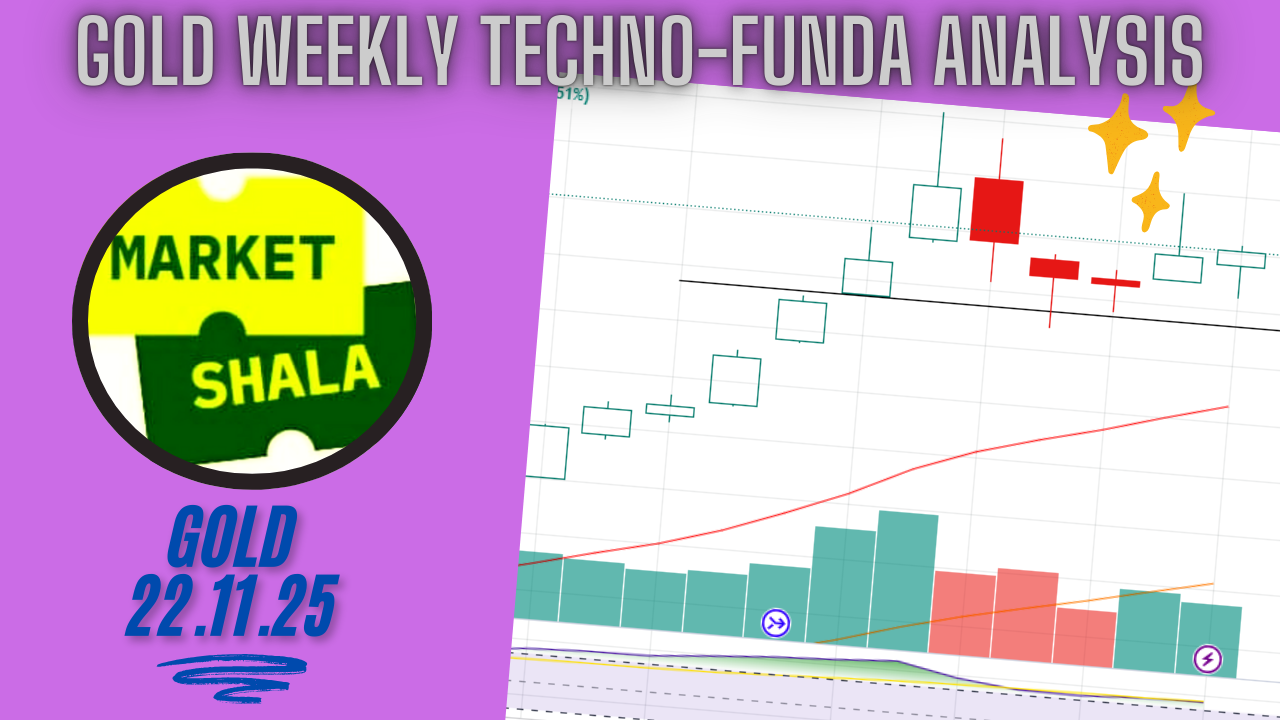
2. The Weekly Chart: Strong Trend, Healthy Pause
The weekly timeframe is the backbone of swing trading and investing. It filters out noise and shows the real direction of smart money.
📌 Trend Structure
- Gold has been moving within a powerful upward trajectory for months.
- Each correction has been shallow, with buyers stepping in almost immediately.
- The recent candles reflect sideways consolidation, which is a sign of strength—not weakness—after a breakout phase.
📌 Price and Moving Averages
- The price remains firmly above the 20, 50, 100, and 200 EMAs.
- When EMAs align in perfect bullish order (20 > 50 > 100 > 200), it often signals a multi-month or multi-quarter bullish cycle.
📌 RSI Behaviour
- Weekly RSI hovering around 75 may scream “overbought,” but in strong trends, RSI can remain elevated for weeks or months.
- This is not a sell signal by itself; instead, it suggests momentum-backed bullishness.
📌 Market Participation (Volume)
- Noticeable volume spikes during the rally validate that the move wasn’t speculative—it had genuine buying interest.
- The drop in volume during consolidation is a healthy sign of absorption rather than distribution.
3. Key Levels Traders Must Watch
Resistance Zone
- ₹124,500 – ₹125,000
Multiple candles have reacted here, making it the natural ceiling for now.
Immediate Support
- ₹121,500 – 122,000
Perfect zone for dip-buyers, as seen from recent weekly candle lows.
Structural Support (Very Important)
- ₹118,800 (20-week EMA)
This acts as a dynamic floor for the ongoing trend.
4. Practical Trading Strategy for the Coming Week
This section is crafted for traders who want clear, real-world approaches—not theoretical ideas.
🟢 Strategy 1: Buy on Dips (Primary Plan)
This is the most practical and trend-aligned approach for the current market.
Entry Zone
- ₹121,500 – 122,000
Look for price stability, long tails, or bullish rejection wicks in this zone.
Stop Loss (Strict)
- ₹118,800 on weekly close
If the market closes below this level, the trend weakens temporarily.
Targets
- Short-Term Target: ₹125,200
- Aggressive Target: ₹126,000+
If price breaks above ₹125,000 with strong volume, bulls might take control rapidly.
Why this Works
- You align with the major trend.
- You avoid buying at the top.
- Your risk is clearly defined.
🔵 Strategy 2: Breakout Buying (Alternative Plan)
For traders who prefer momentum triggers rather than dip entries.
Buy When
- Weekly candle closes above ₹125,000 decisively.
Stop Loss
- ₹122,500 (below breakout zone)
Targets
- ₹128,000 – ₹130,000 (medium-term)
This is suitable for traders comfortable entering strength rather than weakness.
5. Medium-Term Investing Strategy
If you’re an investor looking beyond weekly moves:
Accumulation Approach
- Accumulate 20–25% on each dip toward:
- ₹122,000
- ₹118,800
- Avoid going “all-in” at once. Gold is cyclical, and staggered buying smoothens volatility.
Investment Rationale
- Fundamental backdrop remains strongly supportive.
- Gold often breaks into long upward cycles when global uncertainty peaks.
- Long-term targets over the next 6–12 months can stretch toward ₹130,000 – ₹135,000 if current macro trends persist.
6. What Could Go Wrong? (Risk Assessment)
Even a strong trend demands awareness of what could disrupt it:
- A sudden drop in global inflation could reduce gold’s shine.
- Aggressive rate hikes or a strong USD may cause corrections.
- Breaking below ₹118,800 could trigger deeper declines toward ₹115,500 or even ₹113,000.
Being aware of risks lets you act, not react.
💡 Final Thoughts: What Traders Should Take Away
Gold’s chart is telling us a simple story:
The trend is bullish, the structure is strong, and dips are blessings—not threats—for disciplined traders.
However, the key is to combine:
- patience,
- level-based entries,
- strict risk management,
- and awareness of macro triggers.
Traders who treat gold with respect—and not impulse—often find it rewarding.
Click Here to join our partner Equity / Other Capital Market Investing Platform and unlock MarketShala’s expert-backed investing guidance. For personal assistance, email us at somnath@markshala.com or WhatsApp at +91-8209177236. You may also join our WhatsApp community MarketShalians to stay tuned with regular updates in your wealth creation journey.
Disclaimer
The views and analysis provided above are for educational and informational purposes only and should not be considered as financial or investment advice. Trading and investing in the stock market involve risk, and past performance does not guarantee future results.
***********